Showing posts with label living math. Show all posts

Sunday, August 3, 2008

Icosahedron from picnic supplies

This was such a fun video to watch! This guy makes an icosahedron from plastic plates, and then from plastic cups - and one more from just plastic and duct tape.

It can serve as a fun summer math project for kids who love explorations, cutting, gluing, building, and that sort of stuff!

He is hilarious! See the video:


Video from Makezine.com


Read the instructions for the icosahedrons

Find out what is an icosahedron

Icosahedron from picnic supplies

This was such a fun video to watch! This guy makes an icosahedron from plastic plates, and then from plastic cups - and one more from just plastic and duct tape.

It can serve as a fun summer math project for kids who love explorations, cutting, gluing, building, and that sort of stuff!

He is hilarious! See the video:


Video from Makezine.com


Read the instructions for the icosahedrons

Find out what is an icosahedron

Saturday, July 12, 2008

A Mathematical Trip

Are you perhaps doing any car trips this summer?

Do you realize what a great opportunity it is to teach some real-life math to your children? They need to learn how to calculate the cost of a trip, based on the miles driven, the gas mileage of the car, and the price of gasoline.

So today I want to highlight something sent to me by a fellow homeschooling mom, visitor to my site. She uses math a lot within real-life situations, and recently made a geography-math worksheet for her daughter about calculating the length and cost of a trip their grandparents were doing.

She allowed me to share that worksheet WITH YOU... so here it is (MS Word 7) and here (Word 6). Right-click to save.

See also a travel distance calculator to help you figure out distances.

I quote:

"It's funny, but even with all the resources we currently have on hand, I find that we spend more time on real-life math (such as calculating tip when we eat out). In fact, I just created a "worksheet" (not really, it's just a crude Word document) to cover Geography and Math. It is based on a road trip that my mother is currently making to come and visit us. Each day, we add on to the previous day's calculations. ... The math is actually more advanced than my daughter is currently doing in her "normal" classwork, but I have found that by relating the math to something that has a real-life element, she seems to grasp the concept pretty well. In this particular case, I've told her that it's important for us to know how much the entire trip costs (in terms of gas) and how long the trip takes so that we can plan a reciprocal trip (which she would dearly love to do)!

My initial thought on your worksheets (keeping in mind that we haven't actually used any of them yet and I've only looked over a few), is that they ONLY encompass math (though the same can be said of all the math curricula I have reviewed so far). My preference would be to have math "bundled" with other subjects: Science, Literature, History or (like I attempted to do with my worksheet) Geography.

I homeschool, so I love it when I can accomplish several goals at once. Unit studies tend to cover several core subjects including math, but the primary emphasis is on the central topic. I think that it would be really neat to see a curriculum that was BASED on math and then used other subjects to support the concepts. Just a thought...
"

Lori Nettles

A Mathematical Trip

Are you perhaps doing any car trips this summer?

Do you realize what a great opportunity it is to teach some real-life math to your children? They need to learn how to calculate the cost of a trip, based on the miles driven, the gas mileage of the car, and the price of gasoline.

So today I want to highlight something sent to me by a fellow homeschooling mom, visitor to my site. She uses math a lot within real-life situations, and recently made a geography-math worksheet for her daughter about calculating the length and cost of a trip their grandparents were doing.

She allowed me to share that worksheet WITH YOU... so here it is (MS Word 7) and here (Word 6). Right-click to save.

See also a travel distance calculator to help you figure out distances.

I quote:

"It's funny, but even with all the resources we currently have on hand, I find that we spend more time on real-life math (such as calculating tip when we eat out). In fact, I just created a "worksheet" (not really, it's just a crude Word document) to cover Geography and Math. It is based on a road trip that my mother is currently making to come and visit us. Each day, we add on to the previous day's calculations. ... The math is actually more advanced than my daughter is currently doing in her "normal" classwork, but I have found that by relating the math to something that has a real-life element, she seems to grasp the concept pretty well. In this particular case, I've told her that it's important for us to know how much the entire trip costs (in terms of gas) and how long the trip takes so that we can plan a reciprocal trip (which she would dearly love to do)!

My initial thought on your worksheets (keeping in mind that we haven't actually used any of them yet and I've only looked over a few), is that they ONLY encompass math (though the same can be said of all the math curricula I have reviewed so far). My preference would be to have math "bundled" with other subjects: Science, Literature, History or (like I attempted to do with my worksheet) Geography.

I homeschool, so I love it when I can accomplish several goals at once. Unit studies tend to cover several core subjects including math, but the primary emphasis is on the central topic. I think that it would be really neat to see a curriculum that was BASED on math and then used other subjects to support the concepts. Just a thought...
"

Lori Nettles

Saturday, June 14, 2008

High school math after algebra, geometry, and consumer math?

Question:

"I am a homeschooling mom, with two children still at home. We use Switched On Schoolhouse almost exclusively. My son will be a senior this fall. He took Algebra 1 and geometry but was against taking trig. I had him take Consumer Math this year and I am trying to find him something for his senior year. He is not leaning towards college, but perhaps a tech school. ANY advice you can give will be greatly appreciated! Thanks!"

Well, if you don't want to do trig or algebra 2, consider the book Mathematics, a Human Endeavor: A Textbook for Those Who Think They Don't Like the Subject.

This book by Harold Jacobs covers a wide range of mathematical topics, aiming to show students how interesting math can be. The topics include for example number tricks, inductive reasoning, deductive reasoning, number sequences, functions and their graphs, large numbers and logarithms, polygons and symmetry, mathematical curves, probability, and topology.

Jacobs always gives you problems where you have to investigate and find out patterns. He aims to minimize the usage of formulas, shows all kinds of interesting ideas and tricks, and thus lets the student fall in love with mathematics.

More info:

Harold Jacobs Mathematics Human Endeavor Curriculum

Review by TOS

Review of Harold Jacobs books by Susan Richman.

Mathematics, a Human Endeavor at Amazon.


High school math after algebra, geometry, and consumer math?

Question:

"I am a homeschooling mom, with two children still at home. We use Switched On Schoolhouse almost exclusively. My son will be a senior this fall. He took Algebra 1 and geometry but was against taking trig. I had him take Consumer Math this year and I am trying to find him something for his senior year. He is not leaning towards college, but perhaps a tech school. ANY advice you can give will be greatly appreciated! Thanks!"

Well, if you don't want to do trig or algebra 2, consider the book Mathematics, a Human Endeavor: A Textbook for Those Who Think They Don't Like the Subject.

This book by Harold Jacobs covers a wide range of mathematical topics, aiming to show students how interesting math can be. The topics include for example number tricks, inductive reasoning, deductive reasoning, number sequences, functions and their graphs, large numbers and logarithms, polygons and symmetry, mathematical curves, probability, and topology.

Jacobs always gives you problems where you have to investigate and find out patterns. He aims to minimize the usage of formulas, shows all kinds of interesting ideas and tricks, and thus lets the student fall in love with mathematics.

More info:

Harold Jacobs Mathematics Human Endeavor Curriculum

Review by TOS

Review of Harold Jacobs books by Susan Richman.

Mathematics, a Human Endeavor at Amazon.


Wednesday, September 26, 2007

Math readers

I've had some fun building this page about math readers, or "living math" books for my main site. The list is not terribly long yet, but it will grow, I'm sure.

I discovered that Amazon has all kinds of new "widgets" available to promote their products. What do you think of this? It is a slideshow featuring MathStart readers by Stuart J. Murphy. Hover your mouse over it:


Math story books offer children an interesting way to learn math concepts, to get interested in mathematics, and to explore some fascinating topics outside of the main curriculum. It is one way to bring math to "life". Kids are almost sure to enjoy it.

On my page, I list for example Cryptoclub, a fascinating storybook that teaches how to encrypt and decrypt secrete messages, or The Adventures of Penrose - THE MATHEMATICAL CAT, in which you will encounter many fascinating mathematical topics from fractals to tessellations, or many books for little kids.

I was thinking putting all of that on a blogpost, too, but it's just "duplicate content". Maybe I'll feature a few of them here soon.

I realize not everyone can buy many math readers on top of their regular school books, but try find some of these books in your local library!

Math readers

I've had some fun building this page about math readers, or "living math" books for my main site. The list is not terribly long yet, but it will grow, I'm sure.

I discovered that Amazon has all kinds of new "widgets" available to promote their products. What do you think of this? It is a slideshow featuring MathStart readers by Stuart J. Murphy. Hover your mouse over it:


Math story books offer children an interesting way to learn math concepts, to get interested in mathematics, and to explore some fascinating topics outside of the main curriculum. It is one way to bring math to "life". Kids are almost sure to enjoy it.

On my page, I list for example Cryptoclub, a fascinating storybook that teaches how to encrypt and decrypt secrete messages, or The Adventures of Penrose - THE MATHEMATICAL CAT, in which you will encounter many fascinating mathematical topics from fractals to tessellations, or many books for little kids.

I was thinking putting all of that on a blogpost, too, but it's just "duplicate content". Maybe I'll feature a few of them here soon.

I realize not everyone can buy many math readers on top of their regular school books, but try find some of these books in your local library!

Thursday, April 19, 2007

Math in books (not math books!)

I just recieved an email from a publishing company. They want to send me a few books to review and then list on my site.

I've written reviews before, a whole bunch. I started my "reviewer career"... well, in school of course. We wrote book reviews, as I'm sure you did too. I don't think mine were that special. But somehow the role of reviewer has fallen to my lap nowadays.

For example, recently I just finished the review of YourTeacher and MathScore.

The new books that this email was about are


I haven't seen these yet. The reason I put them in this blogpost is because it sounds like these books are examples of math in a somewhat entertaining or interesting context, aimed at high school or middle-school level.

You know, to so many people math remains a "dull" school subject only. And that is so far from truth. It is some of those same people, I'm sure, who confess to the "I'm bad at math and that's okay" attitude as mentioned in the previous blogpost.

I, for sure, intend for my kids to learn the beauty of math, to learn about some of these interesting subjects such as basic cryptography, to learn even of math history.

There exist lots more books like those above, "living math" books - books where mathematical concepts are at the centerpiece of the story.

I encourage you to do something similar. Don't just use the curriculum. Go to the library, and find some of these kind of books (or buy them). It shows kids so much more about math, inspires them about math, and gets rid of these silly attitudes of math being boring or not worth learning.

Because all in all, we can then appreciate mathematics so much more (and its Creator). People are awed by the animal kingdom and appreciate the beauty of this Earth and its plants, its geography, the planets, space etc. But the same applies to math.

Math in books (not math books!)

I just recieved an email from a publishing company. They want to send me a few books to review and then list on my site.

I've written reviews before, a whole bunch. I started my "reviewer career"... well, in school of course. We wrote book reviews, as I'm sure you did too. I don't think mine were that special. But somehow the role of reviewer has fallen to my lap nowadays.

For example, recently I just finished the review of YourTeacher and MathScore.

The new books that this email was about are


I haven't seen these yet. The reason I put them in this blogpost is because it sounds like these books are examples of math in a somewhat entertaining or interesting context, aimed at high school or middle-school level.

You know, to so many people math remains a "dull" school subject only. And that is so far from truth. It is some of those same people, I'm sure, who confess to the "I'm bad at math and that's okay" attitude as mentioned in the previous blogpost.

I, for sure, intend for my kids to learn the beauty of math, to learn about some of these interesting subjects such as basic cryptography, to learn even of math history.

There exist lots more books like those above, "living math" books - books where mathematical concepts are at the centerpiece of the story.

I encourage you to do something similar. Don't just use the curriculum. Go to the library, and find some of these kind of books (or buy them). It shows kids so much more about math, inspires them about math, and gets rid of these silly attitudes of math being boring or not worth learning.

Because all in all, we can then appreciate mathematics so much more (and its Creator). People are awed by the animal kingdom and appreciate the beauty of this Earth and its plants, its geography, the planets, space etc. But the same applies to math.

Friday, September 8, 2006

Living and Loving Math

X (however many) Habits of Highly Effective Math Teaching:

Part 4: Living and Loving Math


You are the teacher. You show the way - also with your attitudes, your way of life.

Do you use math often in your daily life? Is using mathematical reasoning, numbers, measurements, etc. a natural thing to you every day?

And then: do you like math? Love it? Are you happy to teach it? Enthusiastic?

Both of these tend to show up in how you teach, but especially so in a homeschooling enviroment, because at home you're teaching your kids a way of life, and if math is a natural part of it or not.

Math is not a drudgery, nor something just confined to math lessons.

Some ideas:
  • Let it make sense. This alone can usually make math quite a difference and kids will stay interested.

  • Read through some fun math books, such as Theoni Pappas books, or puzzle-type books. Get to know some interesting math topics besides just schoolbook arithmetic. And, there are even story books to teach math concepts - see a list here.

  • Try including a bit about math history. This might work best in a homeschooling environment where there is no horrible rush to get through the thick book before the year is over. Julie at LivingMath.net has suggestions for math history books to buy.

  • When you use math in your daily life, explain how you're doing it, and include the children if possible. Figure it out together.


I've talked about all this before, so I really don't want to go into repeating myself too much. But I did want to include this principle in my "mini-series" of effective habits of math teaching.

Living and Loving Math

X (however many) Habits of Highly Effective Math Teaching:

Part 4: Living and Loving Math


You are the teacher. You show the way - also with your attitudes, your way of life.

Do you use math often in your daily life? Is using mathematical reasoning, numbers, measurements, etc. a natural thing to you every day?

And then: do you like math? Love it? Are you happy to teach it? Enthusiastic?

Both of these tend to show up in how you teach, but especially so in a homeschooling enviroment, because at home you're teaching your kids a way of life, and if math is a natural part of it or not.

Math is not a drudgery, nor something just confined to math lessons.

Some ideas:
  • Let it make sense. This alone can usually make math quite a difference and kids will stay interested.

  • Read through some fun math books, such as Theoni Pappas books, or puzzle-type books. Get to know some interesting math topics besides just schoolbook arithmetic. And, there are even story books to teach math concepts - see a list here.

  • Try including a bit about math history. This might work best in a homeschooling environment where there is no horrible rush to get through the thick book before the year is over. Julie at LivingMath.net has suggestions for math history books to buy.

  • When you use math in your daily life, explain how you're doing it, and include the children if possible. Figure it out together.


I've talked about all this before, so I really don't want to go into repeating myself too much. But I did want to include this principle in my "mini-series" of effective habits of math teaching.

Wednesday, January 4, 2006

Growing to love or hate math?

Have you ever met anyone who feels, "I hate math", or "I don't understand math at all", or "I'm not a math person" ?

Wonder when and where those feelings got started?

I recently read an article called Formula to bring back thrill to math.
The author argued that calculus should be reserved to college studies, not high school. His point was, while the nation is suffering from a shortage of math teachers, the good math teachers are needed, not at advanced-placement calculus classes, but instructing 'the masses' so that they would learn to love math.

He also said that besides a drastic shortage of math teachers, there is also a severe shortage of math majors. In other words, fewer and fewer kids are studying math as their major in college, and there are fewer and fewer (qualified) math teachers... Of course the result is that schools then hire just about anyone to teach math.

I just wonder, is there a connection between the lack of good math teachers and the common feelings of students of not liking math? And then, less and less youngsters choosing to study math? Is this a vicious cycle?

So what makes one love math or hate math? What makes people hate math?

Categories:

Growing to love or hate math?

Have you ever met anyone who feels, "I hate math", or "I don't understand math at all", or "I'm not a math person" ?

Wonder when and where those feelings got started?

I recently read an article called Formula to bring back thrill to math.
The author argued that calculus should be reserved to college studies, not high school. His point was, while the nation is suffering from a shortage of math teachers, the good math teachers are needed, not at advanced-placement calculus classes, but instructing 'the masses' so that they would learn to love math.

He also said that besides a drastic shortage of math teachers, there is also a severe shortage of math majors. In other words, fewer and fewer kids are studying math as their major in college, and there are fewer and fewer (qualified) math teachers... Of course the result is that schools then hire just about anyone to teach math.

I just wonder, is there a connection between the lack of good math teachers and the common feelings of students of not liking math? And then, less and less youngsters choosing to study math? Is this a vicious cycle?

So what makes one love math or hate math? What makes people hate math?

Categories:

Tuesday, December 20, 2005

Mathematics: The science of patterns

I just started reading the book Mathematics : The Science of Patterns by Keith Devlin. I'm planning on writing a review of it for my site. I can already tell it's a good book, and I've just read the prologue, titled "What is mathematics?"

The author says that yes, mathematics WAS the study of number - up till about 500 B.C. Then it became the study of number and shape. After invention of calculus, it became the study of number, shape, motion, change and space.

But nowadays you can't say that any more, because the field of mathematics has expanded SO much: in 1900 it would have taken about eighty books to write all the world's mathematical knowledge. Devlin estimates that nowadays (or when he wrote the book about 10 years ago) it would take maybe 100,000 volumes to contain all knonw mathematics!

You know, your average person doesn't realize that. I got a glimpse of it while in university, when I saw all these lists of subcategories of mathematics, and when I studied a little bit of something like Abstract Algebra or Complex Analysis or Measure Theory - and all we did was touch the surface of such topics.

And so today, mathematics is often defined as the study of patterns - numerical patterns, patterns of shape, patterns of motion, and so on.

Devlin also touched on beauty in mathematics in his prologue - and I agree: mathematics is beautiful. That, too, I fear, most folks don't realize or understand. It's because you need to be able to understand the math first - then it kind of forms a picture in your mind of a structure that is beautiful, harmonious. I can't explain it.

So I want to recommend the book Mathematics : The Science of Patterns for all of you even before I've written complete review on it. It's written for a layman, and is about the essential history of mathematics.


Categories: ,

Mathematics: The science of patterns

I just started reading the book Mathematics : The Science of Patterns by Keith Devlin. I'm planning on writing a review of it for my site. I can already tell it's a good book, and I've just read the prologue, titled "What is mathematics?"

The author says that yes, mathematics WAS the study of number - up till about 500 B.C. Then it became the study of number and shape. After invention of calculus, it became the study of number, shape, motion, change and space.

But nowadays you can't say that any more, because the field of mathematics has expanded SO much: in 1900 it would have taken about eighty books to write all the world's mathematical knowledge. Devlin estimates that nowadays (or when he wrote the book about 10 years ago) it would take maybe 100,000 volumes to contain all knonw mathematics!

You know, your average person doesn't realize that. I got a glimpse of it while in university, when I saw all these lists of subcategories of mathematics, and when I studied a little bit of something like Abstract Algebra or Complex Analysis or Measure Theory - and all we did was touch the surface of such topics.

And so today, mathematics is often defined as the study of patterns - numerical patterns, patterns of shape, patterns of motion, and so on.

Devlin also touched on beauty in mathematics in his prologue - and I agree: mathematics is beautiful. That, too, I fear, most folks don't realize or understand. It's because you need to be able to understand the math first - then it kind of forms a picture in your mind of a structure that is beautiful, harmonious. I can't explain it.

So I want to recommend the book Mathematics : The Science of Patterns for all of you even before I've written complete review on it. It's written for a layman, and is about the essential history of mathematics.


Categories: ,

Wednesday, November 23, 2005

Fun math and math appreciation

Some of us are math enthusiastics: we love math, think it is full of beauty, logic, and patterns; we think it can be fun, exciting, amusing even. (I include myself in this category.)

And then some of us don't care for math, didn't like it in school, didn't do well in it, don't want anything to do with it anymore. And I'm sure there are people in between these extremes, too.

As a teacher, you would like your students to belong to the first category, of course.

Now, I sincerely think that the biggest factor in whether student ends up liking or hating math is what kind of math teacher and teaching he/she gets. Parents' attitudes play a role too, but teacher's attitude to math and the way math is taught are the weightiest factors, I feel.

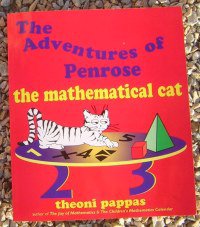
The Adventures of Penrose The Mathematical Cat book coverBut books such as The Adventures of Penrose The Mathematical Cat by Theoni Pappas can help too. It is intended for fun reading, exploring exciting mathematical topics in an easy-to-understand way.

The storyline includes Penrose the mathematical cat who seems pretty lazy but often gets interested in her mistress' math papers and thus ends up learning about this and that in math.
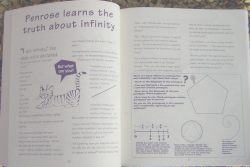
Penrose learns the truth about infinityFor example, you get to encounter 0s and 1s (binary numbers), fractals, infinity, Mobious strip, Pascal triangle, golden rectangles, paperfolding, tessellations, abacus, magic squares, tangrams, nanoworld... For math geeks, these are familiar topics. They show some of the beautiful or fun or intriguing aspects of math.


You could almost say this book is about "Math appreciation". We are told to teach our kids art appreciation, to teach them to appreciate fine arts, paintings, sculptures. In my opinion, learning about these fascinating math topics can go a long way towards teaching children to appreciate math.

Read the complete review here.

Fun math and math appreciation

Some of us are math enthusiastics: we love math, think it is full of beauty, logic, and patterns; we think it can be fun, exciting, amusing even. (I include myself in this category.)

And then some of us don't care for math, didn't like it in school, didn't do well in it, don't want anything to do with it anymore. And I'm sure there are people in between these extremes, too.

As a teacher, you would like your students to belong to the first category, of course.

Now, I sincerely think that the biggest factor in whether student ends up liking or hating math is what kind of math teacher and teaching he/she gets. Parents' attitudes play a role too, but teacher's attitude to math and the way math is taught are the weightiest factors, I feel.

The Adventures of Penrose The Mathematical Cat book coverBut books such as The Adventures of Penrose The Mathematical Cat by Theoni Pappas can help too. It is intended for fun reading, exploring exciting mathematical topics in an easy-to-understand way.

The storyline includes Penrose the mathematical cat who seems pretty lazy but often gets interested in her mistress' math papers and thus ends up learning about this and that in math.

Penrose learns the truth about infinityFor example, you get to encounter 0s and 1s (binary numbers), fractals, infinity, Mobious strip, Pascal triangle, golden rectangles, paperfolding, tessellations, abacus, magic squares, tangrams, nanoworld... For math geeks, these are familiar topics. They show some of the beautiful or fun or intriguing aspects of math.


You could almost say this book is about "Math appreciation". We are told to teach our kids art appreciation, to teach them to appreciate fine arts, paintings, sculptures. In my opinion, learning about these fascinating math topics can go a long way towards teaching children to appreciate math.

Read the complete review here.

Wednesday, November 2, 2005

It's easy when it's Bear Math


Recently we bought this great book in a yard sale, it's called Bears! Bears! Bears! by Scholastic. It comes with a handful of small cute plastic bears.

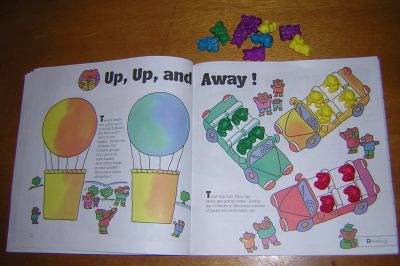
My 3-year old is fascinated by the bears (plays with them all the time) AND by the book, which teaches some early math concepts. For example, it tells to put equal amounts of bears into two balloons (see pic above). Or, set bears sitting facing each other - is one left over - so she can observe even/odd numbers. Or, you can measure by bears since each one is exactly one inch.

A great concept, unfortunately the book is not available much anywhere. Originally it was only distributed via school market. But, some folks sell it used at Amazon (probably the bears will not be included in these used versions, is my guess...).

Anyway, you know it but it's good to be reminded: when it's fun, learning is easy.

It's easy when it's Bear Math


Recently we bought this great book in a yard sale, it's called Bears! Bears! Bears! by Scholastic. It comes with a handful of small cute plastic bears.

My 3-year old is fascinated by the bears (plays with them all the time) AND by the book, which teaches some early math concepts. For example, it tells to put equal amounts of bears into two balloons (see pic above). Or, set bears sitting facing each other - is one left over - so she can observe even/odd numbers. Or, you can measure by bears since each one is exactly one inch.

A great concept, unfortunately the book is not available much anywhere. Originally it was only distributed via school market. But, some folks sell it used at Amazon (probably the bears will not be included in these used versions, is my guess...).

Anyway, you know it but it's good to be reminded: when it's fun, learning is easy.