Showing posts with label fun. Show all posts

Friday, May 13, 2011

New! Fun Mini Post Earrings - 7 colors available

Nouveau!  Boucle d’oreille amusante mini bouton – 7 couleurs disponibles


These studs earrings are so pretty! Perfect for children, teen or a colorful mom!  They are hypoallergenic... especially great for those sensitive to metal.  Made from a lovely green button.  Width of the button: 1.2 cm (7/16 inch).  Available in 7 colors.
 
De nouvelles boucles d’oreille amusantes en boutons pour les enfants. Elles conviennent aussi pour les mamans colorées comme moi qui aiment avoir un brins de couleurs et de jeunesse dans leur tenue. Elles sont hypoallergènes.  Diamètre: 1.2 cm (7/16 pouces).  Disponible en 7 couleurs.


There earrings are available in my zibbet shop:  http://www.zibbet.com/AnnyMay

Ces boucles d'oreille sont disponible dans ma boutique en ligne:  http://annymay.com
 

Wednesday, March 16, 2011

One-minute cool math video

This is a cool 'n' short math video (HT Denise) from a math blog Love 4 Math. My kids laughed... good fun! Good job!

One-minute cool math video

This is a cool 'n' short math video (HT Denise) from a math blog Love 4 Math. My kids laughed... good fun! Good job!

Saturday, August 28, 2010

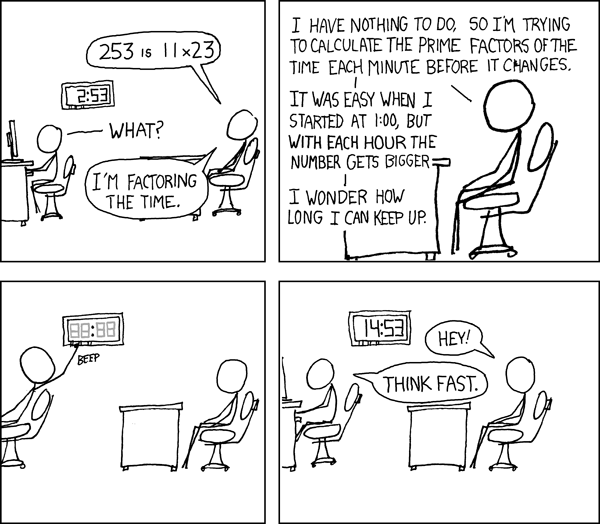
Factoring the time

I stumbled upon this comic that you might enjoy... factoring the time (from xkcd.com).

Factoring the time

I stumbled upon this comic that you might enjoy... factoring the time (from xkcd.com).

Monday, July 19, 2010

Kenken game for summer fun

As most of you are taking a break from math or school work, here's a little (addictive) math game to play online or as printed version: Kenken.

In it, you have to place the numbers in the grid kind of like in Sudoku so that no number appears twice in the same row or column, BUT there's an additional twist: it gives you "cages", and the numbers within a particular cage have to work to a given answer with a given math operation (either addition, subtraction, multiplication, or division).

KenKen practices logical thinking and is, I think, more fun than Sudoku.

It's easier to understand if you go see and try it yourself. The smaller sizes, such as 4x4 game, are great for kids, and the larger ones are good for us adults or older students.
  • Kenken.com has nice Kenken puzzles online plus instructions, but only one for each size.
  • MathDoku.com has an unlimited number of Kenken puzzles to play online in three sizes and several difficulty levels.

Friday, July 2, 2010

Math Jokes 4 Math Folks book

I recently received Math Jokes 4 Mathy Folks from the author, Patrick Vennebush. This is a very comprehensive collection of math-related jokes that all "mathy" people will definitely enjoy, and math teachers could use this book to enliven their lessons.

I have seen several of the jokes on the Internet, but never such a large collection.

The jokes are categories into chapters such as

  • One-Liners, ("A hungry clock goes back four seconds.")
  • Graphic Jokes, (For example, "Cube Roots" picture you see on the cover of the book.)
  • Three Dudes, (An engineer, a mathematician, and a chemist are...)
  • Conversion Chart, (109 antics = 1 gigantic, or 454 graham crackers = 1 pound cake)
  • Professions,("The secretary of defense informed the president, 'Yesterday, three Brazilian soldiers were killed. 'Oh, no!' the president exclaimed. ... 'How many is a brazillion, anyway?' ")
And so on.

In each section, the jokes that require the least math knowledge to understand are first, and then the material "advances". People who have studied math in college will get the most out of it, but there are joke for every level.

Please note the author has included a few bathroom jokes and a few slightly dirty ones - if you don't like those, they can easily be marked over.

Tuesday, April 6, 2010

NEW Sticker Book Now Available

Wow, so fast! The NEW Stick me DAD collaborative stickers book is ready! You can get your own   here :)   I can't believe how fast Yaelfran put it all together - I'm so excited! Participating artists - Tarasartcamp, Irisscchwarz, Tosya, Juan Pez, Heidiburton, Retrowhale, Inaluxe, and Benconservato.  There are 42 stickers in each book! (woo-hoo!) and the sticker book ships from Argentina (where Yaelfran is) to anywhere in the world! For dads all over the place! 

Please see the post below for my six sticker designs (if you're curious).

Friday, August 14, 2009

Review of Algebra Unplugged

Algebra Unplugged coverAlgebra Unplugged by Kenn Amdahl and Jim Loats is not a textbook, nor does it have any exercises. Instead, it is filled with verbose, often humorous explanations of algebra 1 concepts for those who would rather hear or read math explained in many words, instead of in a few symbols.

Algebra Unplugged also often explains the reasons behind some peculiar mathematical notations or terminology, and in general, tells the students WHY things are done the way they are done in your "Real Algebra Book".

Note: the cover image doesn't directly have to do with the contents of the book... the book is not about music, nor graffitis. I think it's just conveying the idea that just like musicians might "jam" freely after the practice, with this book you'll get to experience algebra "freely" after the class.

Excerpt:

The Associative Principle

Organizing your singers into sections won't affect how many are in your choir. Grouping them is creating associations. The associate law recognizes the benefits of confining your tenors to one easy-to-patrol area. Fifteen tenors in a corner is no different from fifteen scattered throughout room. It's just safer.

If all you're doing to a series of numbers is adding them, you can add them one at a time, or you can put them in groups, then add the totals of each group.

I certainly enjoyed reading through the book, and feel it can be very helpful for algebra students who feel "lost" and want to understand more thoroughly how to navigate in the maze of rules, symbols, terminology, and unknowns.

Here's another fun little excerpt to get you a "taste":

Why They Make You Factor

Factoring is, on the surface, a foolish waste of time. You will read many books and factor many polynomials before you have a clue why you are doing it. The next sentence in this book will save you two months of confusion.

We factor to take advantage of some neat properties of zero.

In addition and subtraction problems, zero is powerless. You can add or subtract zero to a number for the rest of your life and you won't change the number at all. But zero become an all-powerful super-hero once you move into the domain of multiplication.

When you multiply any number by zero, you get zero. A million times zero equals zero.

When you divide zero by any number, you get zero. Zero divided by a million equals zero.

But you can't multiply any other two numbers together and get zero. And you can't divide any other number by anything and get zero. If the answer to a multiplication problem is zero, one of the numbers you multiplied must also be zero. And, if the answer to a division problem is zero, your original numerator was zero.

That's why we factor.

By all means, click to Amazon and "click to look inside" the book to read some more and see if you like the style. I did - but I never know if others do, or if teenagers do.

The authors have definitely succeeded in keeping the conversation on a lighthearted level. They make light of mathematicians and mathematics and tenors (of course, some might not like that). The book often uses apples, bananas, rats, kangaroos, catbox, jabberwocky, etc. as variables, instead of always resorting to x, y, and z. The authors let Little Weenie Numbers show us the way when things get complicated (these are 1, 2, 3, 4, 5, 6 and other small, easy-to-handle numbers).

The only complaint I have is that the book could have given a bit more attention to graphing with more graphs and actual visual illustrations. The author Kenn Amdah confesses he is not a visual person, so that is why.

Check also for used copies. The book is listed at both Amazon and Barnes & Noble

Calculus for Cats coverThe same authors have also written Calculus for Cats, a clear and entertaining introduction to the mysteries of calculus. It is written with similar goals in mind. It doesn't contain exercises. For some reason, the analogies to the world of cats didn't quite "jibe" with me as well as the writing in the algebra book. This doesn't mean that that book is not useful; it can be tremendously useful for people who feel intimidated or even dismayed by calculus. It just didn't feel quite as fun to read as the algebra book to me.

This book is also listed at Amazon and Barnes & Noble.

Friday, July 10, 2009

Sticker Math Fun (K-2)

When I was a kid, my mom sometimes bought my brother and me activity books to fill up our summer time. Well, if you're into activity books, here's a Sticker Math Fun by Usborne that I can recommend for summer math learning and practice (grades K-2) (or for later in the school year as well, for that matter).

It has different mathematically-sound activities for addition, subtraction, beginning multiplication, fractions and clock, mostly on about 1st grade level but some for kindergarten and some for 2nd.

It is filled with quite variable and creative activities, and not just dull simple adding and subtracting. The activities include missing addends or subtrahends, number patterns, finding numbers that add up to a certain number, and so on.

It is in full color with kid-friendly imagery.

We bought this book several months ago, and I can say my kindergartner-1st grader has really enjoyed the book! And the third grader has wanted to do several pages as well.

The normal price is $15, but this morning when I checked, you can get copies from Amazon marketplace sellers for less than $5 (with shipping)! Go check it out!

Thursday, April 30, 2009

Paper models for polyhedra

Have you ever wanted to fold a pyramid or some of the other interesting polyhedron out of paper?

At least, take a look at the pictures! www.korthalsaltes.com provides hundreds of free printable paper models for various solids, including platonic solids, pyramids, and lots of polyhedra. Some are available as colored versions also.

Folding and gluing one or two is a great summer math project also, and will keep kids busy for a while.

Wednesday, April 1, 2009

April fun

Just wanted to highlight two April-related posts from Denise:

April Math Calendar - something fun! You can download your own copy for printing.

And:

April Fool's Day: Fun with Math Fallacies

April fun

Just wanted to highlight two April-related posts from Denise:

April Math Calendar - something fun! You can download your own copy for printing.

And:

April Fool's Day: Fun with Math Fallacies

Friday, December 12, 2008

Use that brain

You know the old saying, "Use it or lose it." It definitely applies to our brain, as well, and not just our muscles (it's been proven). Using the brain can even help prevent dementia in seniors!

So, if you feel that your brain isn't getting the exercise it needs amidst all the routine housework, kids schoolwork, holiday preparations, and just life, bookmark the following link list.

Then, every day go to one of the sites on the list, and do one puzzle, riddle, or whatever it might be. There are plenty of sites on the list to keep you busy for a while. It says "50 games" but some of the links go to sites full of games:

50 Fun, Free Web Games to Make Your Brain Smarter, Faster, Sharper

For example, promise yourself to have some brain gym time just before or after you finish reading your favorite blogs or news sites or check email in the morning. It should work!