Showing posts with label calculus. Show all posts

Monday, December 21, 2009

High school math videos - free

Today I wanted to highlight two companies that both offer lots of free high school level math materials in the form of videos. These are real, commercial companies, yet they have chosen to offer the videos online for free. Both have something else they sell, hoping to make some money obviously from that part of the business.

The video content can really be of help for all students, teachers, or parents who need additional help with high school math (algebra, geometry, calculus). And since I'm highlighting these two, if you have a topic you have trouble with (such as polynomials or factoring or inequalities) you can even check out videos for that topic in both places.

1) BrightStorm Math.

They currently have over 2,000 videos available for free - a free registration is required though. Algebra through calculus. What they are selling is test preparation courses.

2) MathTV.com


MathTV.com has over 6,000 free math videos, including some in Spanish. Prealgebra through calculus. What they are selling is their own textbooks, physical and online. However, their online textbooks are available for free for evaluation and class testing through June 2010.

High school math videos - free

Today I wanted to highlight two companies that both offer lots of free high school level math materials in the form of videos. These are real, commercial companies, yet they have chosen to offer the videos online for free. Both have something else they sell, hoping to make some money obviously from that part of the business.

The video content can really be of help for all students, teachers, or parents who need additional help with high school math (algebra, geometry, calculus). And since I'm highlighting these two, if you have a topic you have trouble with (such as polynomials or factoring or inequalities) you can even check out videos for that topic in both places.

1) BrightStorm Math.

They currently have over 2,000 videos available for free - a free registration is required though. Algebra through calculus. What they are selling is test preparation courses.

2) MathTV.com


MathTV.com has over 6,000 free math videos, including some in Spanish. Prealgebra through calculus. What they are selling is their own textbooks, physical and online. However, their online textbooks are available for free for evaluation and class testing through June 2010.

Friday, August 14, 2009

Review of Algebra Unplugged

Algebra Unplugged coverAlgebra Unplugged by Kenn Amdahl and Jim Loats is not a textbook, nor does it have any exercises. Instead, it is filled with verbose, often humorous explanations of algebra 1 concepts for those who would rather hear or read math explained in many words, instead of in a few symbols.

Algebra Unplugged also often explains the reasons behind some peculiar mathematical notations or terminology, and in general, tells the students WHY things are done the way they are done in your "Real Algebra Book".

Note: the cover image doesn't directly have to do with the contents of the book... the book is not about music, nor graffitis. I think it's just conveying the idea that just like musicians might "jam" freely after the practice, with this book you'll get to experience algebra "freely" after the class.

Excerpt:

The Associative Principle

Organizing your singers into sections won't affect how many are in your choir. Grouping them is creating associations. The associate law recognizes the benefits of confining your tenors to one easy-to-patrol area. Fifteen tenors in a corner is no different from fifteen scattered throughout room. It's just safer.

If all you're doing to a series of numbers is adding them, you can add them one at a time, or you can put them in groups, then add the totals of each group.

I certainly enjoyed reading through the book, and feel it can be very helpful for algebra students who feel "lost" and want to understand more thoroughly how to navigate in the maze of rules, symbols, terminology, and unknowns.

Here's another fun little excerpt to get you a "taste":

Why They Make You Factor

Factoring is, on the surface, a foolish waste of time. You will read many books and factor many polynomials before you have a clue why you are doing it. The next sentence in this book will save you two months of confusion.

We factor to take advantage of some neat properties of zero.

In addition and subtraction problems, zero is powerless. You can add or subtract zero to a number for the rest of your life and you won't change the number at all. But zero become an all-powerful super-hero once you move into the domain of multiplication.

When you multiply any number by zero, you get zero. A million times zero equals zero.

When you divide zero by any number, you get zero. Zero divided by a million equals zero.

But you can't multiply any other two numbers together and get zero. And you can't divide any other number by anything and get zero. If the answer to a multiplication problem is zero, one of the numbers you multiplied must also be zero. And, if the answer to a division problem is zero, your original numerator was zero.

That's why we factor.

By all means, click to Amazon and "click to look inside" the book to read some more and see if you like the style. I did - but I never know if others do, or if teenagers do.

The authors have definitely succeeded in keeping the conversation on a lighthearted level. They make light of mathematicians and mathematics and tenors (of course, some might not like that). The book often uses apples, bananas, rats, kangaroos, catbox, jabberwocky, etc. as variables, instead of always resorting to x, y, and z. The authors let Little Weenie Numbers show us the way when things get complicated (these are 1, 2, 3, 4, 5, 6 and other small, easy-to-handle numbers).

The only complaint I have is that the book could have given a bit more attention to graphing with more graphs and actual visual illustrations. The author Kenn Amdah confesses he is not a visual person, so that is why.

Check also for used copies. The book is listed at both Amazon and Barnes & Noble

Calculus for Cats coverThe same authors have also written Calculus for Cats, a clear and entertaining introduction to the mysteries of calculus. It is written with similar goals in mind. It doesn't contain exercises. For some reason, the analogies to the world of cats didn't quite "jibe" with me as well as the writing in the algebra book. This doesn't mean that that book is not useful; it can be tremendously useful for people who feel intimidated or even dismayed by calculus. It just didn't feel quite as fun to read as the algebra book to me.

This book is also listed at Amazon and Barnes & Noble.

Review of Algebra Unplugged

Algebra Unplugged coverAlgebra Unplugged by Kenn Amdahl and Jim Loats is not a textbook, nor does it have any exercises. Instead, it is filled with verbose, often humorous explanations of algebra 1 concepts for those who would rather hear or read math explained in many words, instead of in a few symbols.

Algebra Unplugged also often explains the reasons behind some peculiar mathematical notations or terminology, and in general, tells the students WHY things are done the way they are done in your "Real Algebra Book".

Note: the cover image doesn't directly have to do with the contents of the book... the book is not about music, nor graffitis. I think it's just conveying the idea that just like musicians might "jam" freely after the practice, with this book you'll get to experience algebra "freely" after the class.

Excerpt:

The Associative Principle

Organizing your singers into sections won't affect how many are in your choir. Grouping them is creating associations. The associate law recognizes the benefits of confining your tenors to one easy-to-patrol area. Fifteen tenors in a corner is no different from fifteen scattered throughout room. It's just safer.

If all you're doing to a series of numbers is adding them, you can add them one at a time, or you can put them in groups, then add the totals of each group.

I certainly enjoyed reading through the book, and feel it can be very helpful for algebra students who feel "lost" and want to understand more thoroughly how to navigate in the maze of rules, symbols, terminology, and unknowns.

Here's another fun little excerpt to get you a "taste":

Why They Make You Factor

Factoring is, on the surface, a foolish waste of time. You will read many books and factor many polynomials before you have a clue why you are doing it. The next sentence in this book will save you two months of confusion.

We factor to take advantage of some neat properties of zero.

In addition and subtraction problems, zero is powerless. You can add or subtract zero to a number for the rest of your life and you won't change the number at all. But zero become an all-powerful super-hero once you move into the domain of multiplication.

When you multiply any number by zero, you get zero. A million times zero equals zero.

When you divide zero by any number, you get zero. Zero divided by a million equals zero.

But you can't multiply any other two numbers together and get zero. And you can't divide any other number by anything and get zero. If the answer to a multiplication problem is zero, one of the numbers you multiplied must also be zero. And, if the answer to a division problem is zero, your original numerator was zero.

That's why we factor.

By all means, click to Amazon and "click to look inside" the book to read some more and see if you like the style. I did - but I never know if others do, or if teenagers do.

The authors have definitely succeeded in keeping the conversation on a lighthearted level. They make light of mathematicians and mathematics and tenors (of course, some might not like that). The book often uses apples, bananas, rats, kangaroos, catbox, jabberwocky, etc. as variables, instead of always resorting to x, y, and z. The authors let Little Weenie Numbers show us the way when things get complicated (these are 1, 2, 3, 4, 5, 6 and other small, easy-to-handle numbers).

The only complaint I have is that the book could have given a bit more attention to graphing with more graphs and actual visual illustrations. The author Kenn Amdah confesses he is not a visual person, so that is why.

Check also for used copies. The book is listed at both Amazon and Barnes & Noble

Calculus for Cats coverThe same authors have also written Calculus for Cats, a clear and entertaining introduction to the mysteries of calculus. It is written with similar goals in mind. It doesn't contain exercises. For some reason, the analogies to the world of cats didn't quite "jibe" with me as well as the writing in the algebra book. This doesn't mean that that book is not useful; it can be tremendously useful for people who feel intimidated or even dismayed by calculus. It just didn't feel quite as fun to read as the algebra book to me.

This book is also listed at Amazon and Barnes & Noble.

Tuesday, March 17, 2009

Introducing Make It Real Learning workbooks

I have recently had the pleasure to add Make It Real Learning workbooks to my site. These books contain real-life math activities with real-life data, companies, and situations. They are written by Frank Wilson.

Some examples of the topics included in these activities are: cell phone plans, autism, population growth, cooking, borrowing money, credit cards, life spans, population growth, and music downloads. But there are many more, more than I can list here.

As students work through the problems, they can use the math skills and concepts they have learned in their math curriculum (such as the concept of average or graphing), and apply those to a situation from real life.

Each activity-lesson in the book contains several questions about the situation, starting with basics and going into more in-depth evaluations, and should be adequate for one-two complete class periods.

Why does that benefit you, the teacher? It will motivate the students far more than dull, boring word problems from the textbook. It will show students how mathematics is truly USEFUL. Also:
  • The problems are written by an experienced math teacher (Frank Wilson)

  • The problems are matched to the learning objectives of the National Council of Teachers of Mathematics (NCTM). This means that the concepts and skills required to complete the problems ARE found in typical middle and high school mathematics curriculum. You can simply replace some of the problems in your textbook with these real-life scenarios.

  • These activities are excellent to be used in a small-group setting.

  • Typically, the activities contain challenging parts and therefore allow students to practice real problem solving - not just apply knowledge from textbook examples to other almost identical problems.

  • Gifted students can enjoy the challenge of solving all the questions on their own.

All books include complete solutions to all activities and problems. Please note that Make It Real Learning workbooks do not contain the instruction or explanations of the concepts.

List of available books:

Arithmetic I - for grades 3-6
Fractions, Percents, and Decimals I - for grades 4-8
Fractions, Percents, and Decimals II - for grades 6-11
Sets, Probability, and Statistics I - for grades 6-10

Linear Functions I - for algebra 1 and algebra 2
Linear Functions II - for algebra 1 and algebra 2
Quadratic Functions I - for algebra 1 and algebra 2

Exponential and Logarithmic Functions I
- for algebra 2/precalculus
Periodic and Piecewise Functions I
- for algebra 2/precalculus
Polynomial, Power, Logistic, and Rational Functions I
- for algebra 2/precalculus
Calculus I - for grade 12

Introducing Make It Real Learning workbooks

I have recently had the pleasure to add Make It Real Learning workbooks to my site. These books contain real-life math activities with real-life data, companies, and situations. They are written by Frank Wilson.

Some examples of the topics included in these activities are: cell phone plans, autism, population growth, cooking, borrowing money, credit cards, life spans, population growth, and music downloads. But there are many more, more than I can list here.

As students work through the problems, they can use the math skills and concepts they have learned in their math curriculum (such as the concept of average or graphing), and apply those to a situation from real life.

Each activity-lesson in the book contains several questions about the situation, starting with basics and going into more in-depth evaluations, and should be adequate for one-two complete class periods.

Why does that benefit you, the teacher? It will motivate the students far more than dull, boring word problems from the textbook. It will show students how mathematics is truly USEFUL. Also:
  • The problems are written by an experienced math teacher (Frank Wilson)

  • The problems are matched to the learning objectives of the National Council of Teachers of Mathematics (NCTM). This means that the concepts and skills required to complete the problems ARE found in typical middle and high school mathematics curriculum. You can simply replace some of the problems in your textbook with these real-life scenarios.

  • These activities are excellent to be used in a small-group setting.

  • Typically, the activities contain challenging parts and therefore allow students to practice real problem solving - not just apply knowledge from textbook examples to other almost identical problems.

  • Gifted students can enjoy the challenge of solving all the questions on their own.

All books include complete solutions to all activities and problems. Please note that Make It Real Learning workbooks do not contain the instruction or explanations of the concepts.

List of available books:

Arithmetic I - for grades 3-6
Fractions, Percents, and Decimals I - for grades 4-8
Fractions, Percents, and Decimals II - for grades 6-11
Sets, Probability, and Statistics I - for grades 6-10

Linear Functions I - for algebra 1 and algebra 2
Linear Functions II - for algebra 1 and algebra 2
Quadratic Functions I - for algebra 1 and algebra 2

Exponential and Logarithmic Functions I
- for algebra 2/precalculus
Periodic and Piecewise Functions I
- for algebra 2/precalculus
Polynomial, Power, Logistic, and Rational Functions I
- for algebra 2/precalculus
Calculus I - for grade 12

Sunday, May 25, 2008

I will derive!

Just a fun little song (parody of "I will survive") for all of us who've taken calculus.

I will derive!

Just a fun little song (parody of "I will survive") for all of us who've taken calculus.

Tuesday, October 9, 2007

Archimedes knew more than we thought

This story is fascinating; they found a long-lost works of Archimedes under the text of a prayer book, and used modern technology to "see" under the prayer text.

After the text was recovered, it was discovered that Archimedes actually found some of the principles of calculus, and used them to figure out volumes and areas. He dealt with "actual" and "potential" infinity, which is exactly what calculus is about.

And he lived thousands of years before Newton!

A long-lost text by the ancient Greek mathematician shows that he had begun to discover the principles of calculus.

Archimedes knew more than we thought

This story is fascinating; they found a long-lost works of Archimedes under the text of a prayer book, and used modern technology to "see" under the prayer text.

After the text was recovered, it was discovered that Archimedes actually found some of the principles of calculus, and used them to figure out volumes and areas. He dealt with "actual" and "potential" infinity, which is exactly what calculus is about.

And he lived thousands of years before Newton!

A long-lost text by the ancient Greek mathematician shows that he had begun to discover the principles of calculus.

Thursday, May 11, 2006

Examples of calculus use in medicine?

I got a question,
"I am supposed to teach my calculus class one lesson.
That lesson has to be on something that can be applied
to whatever I am hoping to major in. I am planning on
studying pre-med to become a doctor. Could you tell
me how doctors apply math learned in calculus 1?"

I suspect doctors don't actually use any calculus in their daily work with people. BUT, it is used in medical research and analysis.

For example, calculus concepts are applied in studying how medicines act in the body. I found an article called Half-life and Steady State that talks about how the patient might be taking a medication and all the same time the body is clearing the previous doses... Eventually there comes a "steady state" where the amount of "the amount of drug going in is the same as the amount of drug getting taken out."

QUOTE
Many drug effects occur primarily when the blood level of the drug is either going up or going down. When the drug reaches steady state, these effects can be either attenuated or completely absent. For those of you who are familiar with calculus, one way to understand this is that these effects only take place if there is a first derivative other than zero.

Or, from www.math.gatech.edu/~bourbaki/MapleProjects.html
we find that calculus is used to find out the rate of change of the surface area for a rapidly growing adolescent. This ties in with medicine in the fact that sometimes the drug dosage depends on the size of the individual, and the surface area is one way to measure the size of a person.
QUOTE
"This worksheet, provides a correlation between height, weight, and surface area
for humans as determined by the commonly used West Nomogram. Additionally, partial derivatives (and the chain-rule) are used to find the rate of change of the
surface area for a rapidly growing adolescent."

BIOLOGY and MEDICINE research abound with mathematical models, and calculus is an essential tool for analyzing those models. I personally have not studied these in-depth, but taking a peek in a Calculus for Biology and Medicine course syllabus from a certain community college we find that on that course the students;

QUOTE
1. Analyze allometric models.
2. Analyze models in cell diffusion.
3. Analyze models in population growth models.
4. Analyze models in population biology for interacting species.
5. Analyze models for respiration and control of respiration.
6. Analyze models for cardiac dynamics and control of heart rhythms.
7. Analyze models for neuron dynamics.
8. Analyze models in pharmacology.
9. Utilize a computer-algebra system in a model's analysis.


Calculus is simply an indispesable tool for modern science.

Tags: ,

Examples of calculus use in medicine?

I got a question,
"I am supposed to teach my calculus class one lesson.
That lesson has to be on something that can be applied
to whatever I am hoping to major in. I am planning on
studying pre-med to become a doctor. Could you tell
me how doctors apply math learned in calculus 1?"

I suspect doctors don't actually use any calculus in their daily work with people. BUT, it is used in medical research and analysis.

For example, calculus concepts are applied in studying how medicines act in the body. I found an article called Half-life and Steady State that talks about how the patient might be taking a medication and all the same time the body is clearing the previous doses... Eventually there comes a "steady state" where the amount of "the amount of drug going in is the same as the amount of drug getting taken out."

QUOTE
Many drug effects occur primarily when the blood level of the drug is either going up or going down. When the drug reaches steady state, these effects can be either attenuated or completely absent. For those of you who are familiar with calculus, one way to understand this is that these effects only take place if there is a first derivative other than zero.

Or, from www.math.gatech.edu/~bourbaki/MapleProjects.html
we find that calculus is used to find out the rate of change of the surface area for a rapidly growing adolescent. This ties in with medicine in the fact that sometimes the drug dosage depends on the size of the individual, and the surface area is one way to measure the size of a person.
QUOTE
"This worksheet, provides a correlation between height, weight, and surface area
for humans as determined by the commonly used West Nomogram. Additionally, partial derivatives (and the chain-rule) are used to find the rate of change of the
surface area for a rapidly growing adolescent."

BIOLOGY and MEDICINE research abound with mathematical models, and calculus is an essential tool for analyzing those models. I personally have not studied these in-depth, but taking a peek in a Calculus for Biology and Medicine course syllabus from a certain community college we find that on that course the students;

QUOTE
1. Analyze allometric models.
2. Analyze models in cell diffusion.
3. Analyze models in population growth models.
4. Analyze models in population biology for interacting species.
5. Analyze models for respiration and control of respiration.
6. Analyze models for cardiac dynamics and control of heart rhythms.
7. Analyze models for neuron dynamics.
8. Analyze models in pharmacology.
9. Utilize a computer-algebra system in a model's analysis.


Calculus is simply an indispesable tool for modern science.

Tags: ,

Friday, April 7, 2006

Distance = velocity * time, or Calculus Without Tears

You can learn calculus concepts starting from the formula distance = velocity * time.

Yes, that's true. That's what the book Calculus Without Tears is all about. It starts from the simple situation of a runner running with constant speed (velocity), and goes very step-by-step into actual calculus concepts, such as derivative, area under curve (integration), and differential equations.

The idea of the book is to make basic calculus concepts accessible to younger students, without need of much algebra.

Like I said earlier, calculus is the mathematics of change. It is usually studied as the last course in high school, or early in college studies. So should one study it earlier? I am sure people have varying opinions on that.

Certainly the aim of this book is NOT to further crowd the "mile wide" mathematics curriculum. But it provides something extra for gifted kids, or for students very interested in calculus and math (and physics). It also provides an alternative way to study calculus and can help students understand it better.

I enjoyed reading thru volumes 1 and 2. It is kind of a different approach, but can really make the student think and understand the concepts better. Too often, learning calculus becomes "mindless symbol manipulation" without much insight into what's happening.

Volume 1 of Calculus Without Tears concentrates on motion with constant velocity, modeling that with a function, graphing the situation, derivative in it (the velocity), area under a curve, and differential equations involved.

Volume 2 deals with the 'falling apple' - motion with constant acceleration, which is described by a quadratic function.

Volume 3 is about nature's favorite functions, such as polynomials, the exponential and trigonometric functions, roots and radicals.

So if you're curious, you can read my review, or go see the author William Flannery's site.

Tags: , ,

Distance = velocity * time, or Calculus Without Tears

You can learn calculus concepts starting from the formula distance = velocity * time.

Yes, that's true. That's what the book Calculus Without Tears is all about. It starts from the simple situation of a runner running with constant speed (velocity), and goes very step-by-step into actual calculus concepts, such as derivative, area under curve (integration), and differential equations.

The idea of the book is to make basic calculus concepts accessible to younger students, without need of much algebra.

Like I said earlier, calculus is the mathematics of change. It is usually studied as the last course in high school, or early in college studies. So should one study it earlier? I am sure people have varying opinions on that.

Certainly the aim of this book is NOT to further crowd the "mile wide" mathematics curriculum. But it provides something extra for gifted kids, or for students very interested in calculus and math (and physics). It also provides an alternative way to study calculus and can help students understand it better.

I enjoyed reading thru volumes 1 and 2. It is kind of a different approach, but can really make the student think and understand the concepts better. Too often, learning calculus becomes "mindless symbol manipulation" without much insight into what's happening.

Volume 1 of Calculus Without Tears concentrates on motion with constant velocity, modeling that with a function, graphing the situation, derivative in it (the velocity), area under a curve, and differential equations involved.

Volume 2 deals with the 'falling apple' - motion with constant acceleration, which is described by a quadratic function.

Volume 3 is about nature's favorite functions, such as polynomials, the exponential and trigonometric functions, roots and radicals.

So if you're curious, you can read my review, or go see the author William Flannery's site.

Tags: , ,

Monday, April 3, 2006

What is calculus?

I recently read a calculus book (actually two) that brought me to reflect what IS calculus.

First of all, let me state what calculus is not:
  • Calculus is NOT the epitome of math, the highest mathematics there is, or anything such like.

So what is calculus? It is basically the mathematics of change. Calculus allows us to study a thing that's changing (represented by some function), and the RATE of that change.

I'll give you an example.


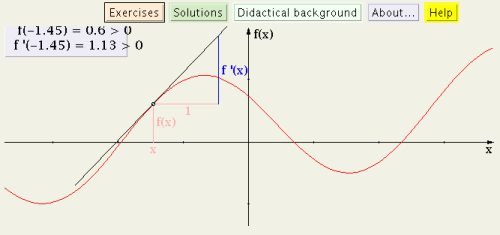
Suppose you have a graph like the one below. Maybe this function (the red one) is depicting how temperature (or voltage or some other thing) changes over time.

The black straight line is a tangent to the function - in other words it "touches" the function in one point. The steepness of the tangent tells us how steep the function itself is going at that point.

Imagine that the tangent (the black straight line) was drawn into a point a little further on the red graph. The red function is increasing but it's coming to a 'hill'. When nearing the hilltop, the tangent wouldn't be as steep as the one that is drawn. It would be less "slanted".

The steepness of the tangent tells us HOW quickly the function itself is changing at that point. And that is one fundamental idea of calculus - the derivative - rate of change. Not just change but rate of change, how quickly the change is taking place.

You can see this picture plus some derivative puzzles at Maths Online Gallery.

Calculus is called the pillar or foundation of modern mathematics. It is the form of math that has allowed us to have our modern technology. Calculus is used extensively in all engineering, physics, biology, chemistry, economy, and other sciences. It allows people to study change, rate of change, and points where the rate of change is zero - maxima and minima.

I liked calculus a lot in my university studies. It seemed to me to be powerful, awesome stuff. And I'm not alone in feeling that way:
"...think of it as a hike over a mountain pass. Yes it's hard work to trudge up the slopes. And yes, you long to rest in the valley that lies on the other side. But the view from up there is breathtaking."

Karl Hahn

"...every once in a while, one of these concepts smacks us on the head, and, after we recover from the stun, we all "Ohhhhh!" together in understanding and awe of the power of mathematics."

Fairfield High School
AP Calcucus Home Page


Tags:

What is calculus?

I recently read a calculus book (actually two) that brought me to reflect what IS calculus.

First of all, let me state what calculus is not:
  • Calculus is NOT the epitome of math, the highest mathematics there is, or anything such like.

So what is calculus? It is basically the mathematics of change. Calculus allows us to study a thing that's changing (represented by some function), and the RATE of that change.

I'll give you an example.


Suppose you have a graph like the one below. Maybe this function (the red one) is depicting how temperature (or voltage or some other thing) changes over time.

The black straight line is a tangent to the function - in other words it "touches" the function in one point. The steepness of the tangent tells us how steep the function itself is going at that point.

Imagine that the tangent (the black straight line) was drawn into a point a little further on the red graph. The red function is increasing but it's coming to a 'hill'. When nearing the hilltop, the tangent wouldn't be as steep as the one that is drawn. It would be less "slanted".

The steepness of the tangent tells us HOW quickly the function itself is changing at that point. And that is one fundamental idea of calculus - the derivative - rate of change. Not just change but rate of change, how quickly the change is taking place.

You can see this picture plus some derivative puzzles at Maths Online Gallery.

Calculus is called the pillar or foundation of modern mathematics. It is the form of math that has allowed us to have our modern technology. Calculus is used extensively in all engineering, physics, biology, chemistry, economy, and other sciences. It allows people to study change, rate of change, and points where the rate of change is zero - maxima and minima.

I liked calculus a lot in my university studies. It seemed to me to be powerful, awesome stuff. And I'm not alone in feeling that way:
"...think of it as a hike over a mountain pass. Yes it's hard work to trudge up the slopes. And yes, you long to rest in the valley that lies on the other side. But the view from up there is breathtaking."

Karl Hahn

"...every once in a while, one of these concepts smacks us on the head, and, after we recover from the stun, we all "Ohhhhh!" together in understanding and awe of the power of mathematics."

Fairfield High School
AP Calcucus Home Page


Tags: