Showing posts with label trigonometry. Show all posts

Tuesday, January 9, 2007

Trigonometry: Finding the value of sine Pi/3.

Trigonometry: Finding the value of sine Pi/3.

First we need to remember that the whole circle is 360° and in radians it is 2Pi. So then Pi is 180°, and Pi/3 is 60°.

To find sine of Pi/3, you'd want to have a right triangle with one angle 60°.

Fortunately that is easy to come by; just take an equilateral triangle and draw an altitude to it. You will have two identical 30°-60°-90° triangles.

And yes this is one of the special triangles - also used in drafting, and there are rulers in this shape.


Where on this picture is the 60° angle? Where's the 30° angle?


Now, to get sine 60° one needs side lengths. I made the sides of this equilateral triangle ABC to be 2 units. The side CD is obviously just 1 unit (easy numbers thus far!)

But what about the height h?

Well, that's where we need to dig up the goold ole' Pythagoras. Can't forget him.

You write the equation, h2 + 12 = 22

h2 = 22 − 12 = 3.

So taking square roots... h = √3.

Then, to the sine.

Remember sine is a ratio of side lengths; it is the ratio of the OPPOSITE side to the hypotenuse.

....and soon you will have the answer: sine 60° is _____ (fill in the blank.)

So it was easy, just using the very basics of trigonometry.

However, I wouldn't memorize the result. Just remember the idea HOW it was derived; and you can derive it when you need it (such as in a test).

Read also:
Special Right Triangles

Trigonometry: Finding the value of sine Pi/3.

Trigonometry: Finding the value of sine Pi/3.

First we need to remember that the whole circle is 360° and in radians it is 2Pi. So then Pi is 180°, and Pi/3 is 60°.

To find sine of Pi/3, you'd want to have a right triangle with one angle 60°.

Fortunately that is easy to come by; just take an equilateral triangle and draw an altitude to it. You will have two identical 30°-60°-90° triangles.

And yes this is one of the special triangles - also used in drafting, and there are rulers in this shape.


Where on this picture is the 60° angle? Where's the 30° angle?


Now, to get sine 60° one needs side lengths. I made the sides of this equilateral triangle ABC to be 2 units. The side CD is obviously just 1 unit (easy numbers thus far!)

But what about the height h?

Well, that's where we need to dig up the goold ole' Pythagoras. Can't forget him.

You write the equation, h2 + 12 = 22

h2 = 22 − 12 = 3.

So taking square roots... h = √3.

Then, to the sine.

Remember sine is a ratio of side lengths; it is the ratio of the OPPOSITE side to the hypotenuse.

....and soon you will have the answer: sine 60° is _____ (fill in the blank.)

So it was easy, just using the very basics of trigonometry.

However, I wouldn't memorize the result. Just remember the idea HOW it was derived; and you can derive it when you need it (such as in a test).

Read also:
Special Right Triangles

Sunday, July 9, 2006

Measuring sine

I get lots of questions, seemingly, about sine. It's because one of my pages with that topic ranks well in search engines and has the comment box in the end. Here's another one:

how to measure right triangle sine?


Well, you don't measure the sine per se. You measure certain sides of the triangle, and then calculate the sine.

sine in a right triangle

For example, in this picture, if we want to find the sine of the angle α, we measure the opposite side and the hypotenuse. They are already given as 2.6 and 6 units. Then just take their ratio: 2.6/6 and that's your sin α.

You might also enjoy reading my lesson about sine in a right triangle.


Tags: ,

Measuring sine

I get lots of questions, seemingly, about sine. It's because one of my pages with that topic ranks well in search engines and has the comment box in the end. Here's another one:

how to measure right triangle sine?


Well, you don't measure the sine per se. You measure certain sides of the triangle, and then calculate the sine.

sine in a right triangle

For example, in this picture, if we want to find the sine of the angle α, we measure the opposite side and the hypotenuse. They are already given as 2.6 and 6 units. Then just take their ratio: 2.6/6 and that's your sin α.

You might also enjoy reading my lesson about sine in a right triangle.


Tags: ,

Wednesday, June 21, 2006

Sketching sine wave

Another (student?) question along trigonometry lines:

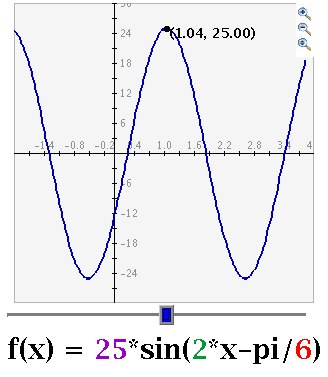
Sketch the sinusodial waveform given below over one complete cycle showing all essential values. i = 25sin(2t-30degress).


Use a graphic calculator or an online version, such as
Function Flyer at Shodor.org
.

There are more online graphing resources at my site.

You need to change the 30 degrees to radians first.

So compare 30 to 360; 30/360 is same as 1/12. So take 1/12th part of 2π, which is π/6.

Then enter the function. With the Shodor grapher, you need to use * for multiplication and x for variable, instead of t, and not use degrees but radians.

sine wave


Seeing the sine graph will surely help you sketch yours on paper. Obviously the highest value is 25, the minimum value is -25.

To find its zeros, you need to think:

When does sin y = 0????

It's when y = _______ or y = _______ or when y = ______ (there are tons of these of course since it's cyclical).

Now take the argument 2t-π/6 and let it equal those numbers you found.

2t-π/6 = ___________ or 2t-π/6 = ___________ or ....

Then solve for t.


You should get π/12, 7π/12, 13π/12, 19π/12 etc. as zeros. It has zeros every
6π/12 or every π/2, and its period is π.

To find where it reaches the highest value 25 and lowest value -25, just take the exact midpoint of two consecutive zeroes. (We don't need calculus this time since it's just a simple sine).

Since midpoint of 1/12 and 7/12 is 4/12, this function has a maximum at x = 4π/12, and then a minimum at 10π/12.


P.S. I'm soon going to have a blog contest with giveaways.


Tags: , ,

Sketching sine wave

Another (student?) question along trigonometry lines:

Sketch the sinusodial waveform given below over one complete cycle showing all essential values. i = 25sin(2t-30degress).


Use a graphic calculator or an online version, such as
Function Flyer at Shodor.org
.

There are more online graphing resources at my site.

You need to change the 30 degrees to radians first.

So compare 30 to 360; 30/360 is same as 1/12. So take 1/12th part of 2π, which is π/6.

Then enter the function. With the Shodor grapher, you need to use * for multiplication and x for variable, instead of t, and not use degrees but radians.

sine wave


Seeing the sine graph will surely help you sketch yours on paper. Obviously the highest value is 25, the minimum value is -25.

To find its zeros, you need to think:

When does sin y = 0????

It's when y = _______ or y = _______ or when y = ______ (there are tons of these of course since it's cyclical).

Now take the argument 2t-π/6 and let it equal those numbers you found.

2t-π/6 = ___________ or 2t-π/6 = ___________ or ....

Then solve for t.


You should get π/12, 7π/12, 13π/12, 19π/12 etc. as zeros. It has zeros every
6π/12 or every π/2, and its period is π.

To find where it reaches the highest value 25 and lowest value -25, just take the exact midpoint of two consecutive zeroes. (We don't need calculus this time since it's just a simple sine).

Since midpoint of 1/12 and 7/12 is 4/12, this function has a maximum at x = 4π/12, and then a minimum at 10π/12.


P.S. I'm soon going to have a blog contest with giveaways.


Tags: , ,