Showing posts with label multiplication. Show all posts

Monday, April 5, 2010

Teaching long multiplication a.k.a multiplying in columns)

The two videos below show how you could teach multi-digit multiplication, or the multiplication algorithm, or multiplying in columns to students.


Teaching multiplication algorithm


Multiplication algorithm with a 2-digit multiplier


I approach this in steps. First, to teach students to multiply 4 × 87 or 5 × 928 (one factor is single-digit):

1) Teach students to multiply single-digit numbers by whole tens and hundreds.
2) Teach them the partial products algorithm;
3) Use the above as a stepping stone and teach the usual multiplication algorithm.

Then we can go on to the two-digit multiplier:

4) Teach the partial products again.
5) Teach the regular form of the algorithm.


Let's look at these steps in more detail.

Step 1. This means teaching students to multiply 5 × 80 or 7 × 400 or 3 × 40 or 9 × 900 (mentally!). The shortcut is to multiply without the zero or zeros, then tag the zero or zeros to the result.

But, where does it come from? For example, 5 × 80 is the same as 5 × 8 × 10. We first multiply 5 × 8 and then multiply that result by 10.

Step 2 is the partial products algorithm. Here, we write the numbers under each other, just like in the regular multiplication algorithm. But the multiplying is done in two (or three) parts: first the ones, then the tens, and then the hundreds (if any).


Step 3. After this, you would teach the usual multiplication algorithm. Point out to students how the two multiplications and the addition (the carry) are done at the same time, instead of as separate calculations.

This step needs practiced quite a bit before moving on so that students become confident in the carrying process.

Step 4a has to do with learning to multiply 50 × 46 or 70 × 352 or 600 × 529 in columns, using the regular algorithm. It is like multiplying 5 × 46 and tagging a zero, or multiplying 6 × 529 and tagging two zeros, but we place those extra zeros in the result first, before multiplying.

3 1 5
4 6 5 2 9
x 5 0 x 6 0 0
-------- ------------
2 3 0 0 3 1 7 4 0 0

The bolded and underlined zeros are placed there before multiplying. The second video makes this maybe even clearer.

Step 4b has to do with multiplications by a 2-digit multiplier, such as 45 × 89. Here, we'd first multiply 40 × 89, then 5 × 89 (using the regular algorithm), and then add the two results. So this means, first of all, three separate calculations.

Step 5: We show students the regular form of the multiplying in columns with a two-digit multiplier, and point out how those three separate calculations are now compactly written under each other.

That's it in a nutshell! Please watch the videos to make this even more clear.

Teaching long multiplication a.k.a multiplying in columns)

The two videos below show how you could teach multi-digit multiplication, or the multiplication algorithm, or multiplying in columns to students.


Teaching multiplication algorithm


Multiplication algorithm with a 2-digit multiplier


I approach this in steps. First, to teach students to multiply 4 × 87 or 5 × 928 (one factor is single-digit):

1) Teach students to multiply single-digit numbers by whole tens and hundreds.
2) Teach them the partial products algorithm;
3) Use the above as a stepping stone and teach the usual multiplication algorithm.

Then we can go on to the two-digit multiplier:

4) Teach the partial products again.
5) Teach the regular form of the algorithm.


Let's look at these steps in more detail.

Step 1. This means teaching students to multiply 5 × 80 or 7 × 400 or 3 × 40 or 9 × 900 (mentally!). The shortcut is to multiply without the zero or zeros, then tag the zero or zeros to the result.

But, where does it come from? For example, 5 × 80 is the same as 5 × 8 × 10. We first multiply 5 × 8 and then multiply that result by 10.

Step 2 is the partial products algorithm. Here, we write the numbers under each other, just like in the regular multiplication algorithm. But the multiplying is done in two (or three) parts: first the ones, then the tens, and then the hundreds (if any).


Step 3. After this, you would teach the usual multiplication algorithm. Point out to students how the two multiplications and the addition (the carry) are done at the same time, instead of as separate calculations.

This step needs practiced quite a bit before moving on so that students become confident in the carrying process.

Step 4a has to do with learning to multiply 50 × 46 or 70 × 352 or 600 × 529 in columns, using the regular algorithm. It is like multiplying 5 × 46 and tagging a zero, or multiplying 6 × 529 and tagging two zeros, but we place those extra zeros in the result first, before multiplying.

3 1 5
4 6 5 2 9
x 5 0 x 6 0 0
-------- ------------
2 3 0 0 3 1 7 4 0 0

The bolded and underlined zeros are placed there before multiplying. The second video makes this maybe even clearer.

Step 4b has to do with multiplications by a 2-digit multiplier, such as 45 × 89. Here, we'd first multiply 40 × 89, then 5 × 89 (using the regular algorithm), and then add the two results. So this means, first of all, three separate calculations.

Step 5: We show students the regular form of the multiplying in columns with a two-digit multiplier, and point out how those three separate calculations are now compactly written under each other.

That's it in a nutshell! Please watch the videos to make this even more clear.

Friday, January 29, 2010

Multiply and divide decimals by powers of ten (by 10, 100, 1000 etc.)

In this video I show, first of all, the common shortcut: you move the decimal point in the number as many steps as there are zeros in the number 10, 100, 1000 etc. For example:

2.16 × 10,000 = 21,600.0
It is as if the point moved four steps from between 2 and 1 to between zeros.

You can see better examples of this in my lesson Multiply and Divide Decimals by 10, 100, and 100 at HomeschoolMath.net.

Then, I also show where this shortcut originates, using PLACE VALUE charts. In reality, it's not the decimal point moving (it's sort of an illusion), but the digits of the number move within the place value chart (to the opposite direction from the way the decimal point seems to "move"). This explanation can really help students to understand the reason behind the "trick" of moving the decimal point.


Multiply & Divide Decimals by powers of ten

Multiply and divide decimals by powers of ten (by 10, 100, 1000 etc.)

In this video I show, first of all, the common shortcut: you move the decimal point in the number as many steps as there are zeros in the number 10, 100, 1000 etc. For example:

2.16 × 10,000 = 21,600.0
It is as if the point moved four steps from between 2 and 1 to between zeros.

You can see better examples of this in my lesson Multiply and Divide Decimals by 10, 100, and 100 at HomeschoolMath.net.

Then, I also show where this shortcut originates, using PLACE VALUE charts. In reality, it's not the decimal point moving (it's sort of an illusion), but the digits of the number move within the place value chart (to the opposite direction from the way the decimal point seems to "move"). This explanation can really help students to understand the reason behind the "trick" of moving the decimal point.


Multiply & Divide Decimals by powers of ten

Friday, August 28, 2009

Math trick and its proof: square a number ending in 5

I will be hosting the blog carnival Math Teachers at Play next week. (You can send in submissions here.)

One submission I got about various multiplication tricks or shortcuts got me inspired to write a proof of the particular trick.

You could definitely use this in algebra class. First explain the shortcut or trick itself. Then ask students to prove it, or to explain WHY it works, using algebra.

You could also explain this to younger students as an additional "neat trick" and let them explore and play with it.

THE "TRICK"

If a number ends in 5, then its square can be calculated using this "trick" (I like to call it a shortcut because there's nothing magic about it):

Let's say we have 75 × 75 => Go 7 × 8 = 56. Then tag 25 (or 5 × 5) into that. You get 5625.

Let's say we have 35 × 35 => Go 3 × 4 = 12. Then tag 25 into that. You get 1225.

Let's say we have 115 × 115 => Go 11 × 12 = 132. Then tag 25 into that. You get 13,225.

Let's say we have 245 × 245 => Go 24 × 25 = 600. Then tag 25 into that. You get 60,025.

So, you simply take the digit or digits in front of the 5 and consider those as a number in itself. Multiply that by the next number. Then "tag" 25 to the answer you got in the previous step.


PROOF

Any whole number that ends in five is of the form A + 5, and A is a multiple of 10. Since A is a multiple of 10, we can write A = 10b, where b is now some whole number. So, our number is of the form 10b + 5. Now, let's square it.

(10b + 5)(10b + 5) and we use the distributive property to multiply this out.

(10b + 5)(10b + 5) = 100b2 + 50b + 50b + 25 = 100b2 + 100b + 25

Now, notice those 100b's there. We can gather that as a common factor for the first two terms:

= 100 b (b + 1) + 25

This is now essentially in the form that the trick is using.

The trick says to take b, or the number formed by the digits in front of the 5. That corresponds exactly with our b! (For example, in number 645, b is 64. Our number 645 is 10b + 5, or 640 + 5.)

So we take b, multiply it by (b + 1) which is the next number, and also by 100, and lastly add 25.

Now, b × (b+1) is the part of the trick where you multiply the digits in front of the 5 by the next number. To "tag" 25 to those digits means you add 25 only after having multiplied the number by 100 so that it would end in "00". Once it ends in "00" you can add 25 (or any two-digit number) and it is the same as "tagging" 25 to the digits without the "00".

I hope this is clear enough.

By the way, I do not feel all students must learn this shortcut for finding the square of numbers ending in 5. It is a nice addition to one's mathematical knowledge, but not any necessity. However, it is useful as an algebra problem, and of course has been used as such over the course of centuries, I'm sure.

Math trick and its proof: square a number ending in 5

I will be hosting the blog carnival Math Teachers at Play next week. (You can send in submissions here.)

One submission I got about various multiplication tricks or shortcuts got me inspired to write a proof of the particular trick.

You could definitely use this in algebra class. First explain the shortcut or trick itself. Then ask students to prove it, or to explain WHY it works, using algebra.

You could also explain this to younger students as an additional "neat trick" and let them explore and play with it.

THE "TRICK"

If a number ends in 5, then its square can be calculated using this "trick" (I like to call it a shortcut because there's nothing magic about it):

Let's say we have 75 × 75 => Go 7 × 8 = 56. Then tag 25 (or 5 × 5) into that. You get 5625.

Let's say we have 35 × 35 => Go 3 × 4 = 12. Then tag 25 into that. You get 1225.

Let's say we have 115 × 115 => Go 11 × 12 = 132. Then tag 25 into that. You get 13,225.

Let's say we have 245 × 245 => Go 24 × 25 = 600. Then tag 25 into that. You get 60,025.

So, you simply take the digit or digits in front of the 5 and consider those as a number in itself. Multiply that by the next number. Then "tag" 25 to the answer you got in the previous step.


PROOF

Any whole number that ends in five is of the form A + 5, and A is a multiple of 10. Since A is a multiple of 10, we can write A = 10b, where b is now some whole number. So, our number is of the form 10b + 5. Now, let's square it.

(10b + 5)(10b + 5) and we use the distributive property to multiply this out.

(10b + 5)(10b + 5) = 100b2 + 50b + 50b + 25 = 100b2 + 100b + 25

Now, notice those 100b's there. We can gather that as a common factor for the first two terms:

= 100 b (b + 1) + 25

This is now essentially in the form that the trick is using.

The trick says to take b, or the number formed by the digits in front of the 5. That corresponds exactly with our b! (For example, in number 645, b is 64. Our number 645 is 10b + 5, or 640 + 5.)

So we take b, multiply it by (b + 1) which is the next number, and also by 100, and lastly add 25.

Now, b × (b+1) is the part of the trick where you multiply the digits in front of the 5 by the next number. To "tag" 25 to those digits means you add 25 only after having multiplied the number by 100 so that it would end in "00". Once it ends in "00" you can add 25 (or any two-digit number) and it is the same as "tagging" 25 to the digits without the "00".

I hope this is clear enough.

By the way, I do not feel all students must learn this shortcut for finding the square of numbers ending in 5. It is a nice addition to one's mathematical knowledge, but not any necessity. However, it is useful as an algebra problem, and of course has been used as such over the course of centuries, I'm sure.

Wednesday, November 19, 2008

Decimal multiplication

This is a tough topic... in a sense. It is not difficult at all, if you just follow the rule given in your math textbook, because the rule is pretty straightforward:
  • To multiply decimal numbers, multiply them as if there were no decimal points, and then put as many decimal digits in the answer as there are total in the factors.
The difficulty is only if you try to understand why we have such a rule - where does it come from?

Understanding the rule for decimal multiplication is actually fairly simple, because it comes from fraction multiplication. But, I will propose here a little different way of explaining all this.

First, look over this decimal multiplication lesson that is taken from Math Mammoth Decimals 2 book.

It talks about how 0.4 × 45 is like taking 4/10 part of 45. The same applies if you have 0.4 × 0.9 - you can think of it as taking 4/10 part of 0.9.

Can you see now why the answer to 0.4 × 0.9 has to be smaller than 0.9?

Or, turn it around: 0.9 × 0.4 is taking 9/10 of 0.4, and so the answer has to be smaller than 0.4 (slightly smaller).

Thinking this way, it shouldn't be a big surprise that 0.9 × 0.4 equals 0.36. (The student needs to have a solid grasp of decimal place value prior to this so he can immediately see that 0.36 is smaller than 0.4.)

Now, once your student is comfortable with this idea (as explained in the lesson), then you can proceed on with the explanation based on fraction multiplication. See, we're taking it one step at a time!


Comparing fraction multiplication and decimal multiplication
(I have not yet written a lesson about this for my books, but will do so for the Light Blue 5-B.)

Remember, decimals are fractions.

Let's take an easy example first.
0.5 × 0.7 is solved with fractions like this:

(5/10) × (7/10) = 35/100 = 0.35
Notice the denominators 10 and 10 got multiplied to produce the denominator 100 for the answer, and so the answer written as a decimal has two decimal digits.

Another example:
0.384 × 2.91

= (384/1000) × (291/100)

= (384 × 291) / (1000 × 100)

= 111744 / 100000

= 1.11744

The denominators 1000 and 100 have as many zeros as as you have decimal digits in the number. The denominator of the answer is 100,000 — with 5 zeros — so the answer as a decimal has five decimal digits.

One more time:
0.45 × 1.3

= (45/100) × (13/10)

= (45 × 13) / (100 × 10)

= 585 / 1000

= 0.585

So... when you write decimals as fractions, the denominators are powers of ten that have as many zeros as there are decimal digits in the decimal number. When you multiply, those denominators get multiplied, and you get another power of ten that has as many zeros as there were in the factors. That, in turn, translates being a decimal number with as many decimal digits as there were decimal digits in the factors.

(In case you don't know: powers of ten are the numbers 101, 102, 103, 104, 105, and so on. Written without the exponential notation these are 10; 100; 1000; 10,000; 100,000; and so on.)

Decimal multiplication

This is a tough topic... in a sense. It is not difficult at all, if you just follow the rule given in your math textbook, because the rule is pretty straightforward:
  • To multiply decimal numbers, multiply them as if there were no decimal points, and then put as many decimal digits in the answer as there are total in the factors.
The difficulty is only if you try to understand why we have such a rule - where does it come from?

Understanding the rule for decimal multiplication is actually fairly simple, because it comes from fraction multiplication. But, I will propose here a little different way of explaining all this.

First, look over this decimal multiplication lesson that is taken from Math Mammoth Decimals 2 book.

It talks about how 0.4 × 45 is like taking 4/10 part of 45. The same applies if you have 0.4 × 0.9 - you can think of it as taking 4/10 part of 0.9.

Can you see now why the answer to 0.4 × 0.9 has to be smaller than 0.9?

Or, turn it around: 0.9 × 0.4 is taking 9/10 of 0.4, and so the answer has to be smaller than 0.4 (slightly smaller).

Thinking this way, it shouldn't be a big surprise that 0.9 × 0.4 equals 0.36. (The student needs to have a solid grasp of decimal place value prior to this so he can immediately see that 0.36 is smaller than 0.4.)

Now, once your student is comfortable with this idea (as explained in the lesson), then you can proceed on with the explanation based on fraction multiplication. See, we're taking it one step at a time!


Comparing fraction multiplication and decimal multiplication
(I have not yet written a lesson about this for my books, but will do so for the Light Blue 5-B.)

Remember, decimals are fractions.

Let's take an easy example first.
0.5 × 0.7 is solved with fractions like this:

(5/10) × (7/10) = 35/100 = 0.35
Notice the denominators 10 and 10 got multiplied to produce the denominator 100 for the answer, and so the answer written as a decimal has two decimal digits.

Another example:
0.384 × 2.91

= (384/1000) × (291/100)

= (384 × 291) / (1000 × 100)

= 111744 / 100000

= 1.11744

The denominators 1000 and 100 have as many zeros as as you have decimal digits in the number. The denominator of the answer is 100,000 — with 5 zeros — so the answer as a decimal has five decimal digits.

One more time:
0.45 × 1.3

= (45/100) × (13/10)

= (45 × 13) / (100 × 10)

= 585 / 1000

= 0.585

So... when you write decimals as fractions, the denominators are powers of ten that have as many zeros as there are decimal digits in the decimal number. When you multiply, those denominators get multiplied, and you get another power of ten that has as many zeros as there were in the factors. That, in turn, translates being a decimal number with as many decimal digits as there were decimal digits in the factors.

(In case you don't know: powers of ten are the numbers 101, 102, 103, 104, 105, and so on. Written without the exponential notation these are 10; 100; 1000; 10,000; 100,000; and so on.)

Sunday, November 2, 2008

Multiplication family group

The information below is from another Maria, namely MariaD from NaturalMath.com. I'm posting it here with her permission, as it might interest some of my readers.

Hello!

My name is MariaD, and I love multiplication. Natural Math is starting a research and development family group about this topic. You are cordially invited! Please forward this invitation to other families who may want to join.

There are three main benefits. You receive individual family math coaching. You access a community of other parents sharing questions and ideas. And you contribute to a beautiful and much needed web resource for the future. There are two main responsibilities. At least weekly, you will run custom family math activities you select. As needed, you will talk with me or other group members about your activities. We can talk by email, chat, voice, or face-to-face in Cary, North Carolina, USA. At this early stage, we need active group members. If you plan to be a quiet fly on the wall, please wait until the next round of development. Time estimate is that the group will provide your family at least an hour a week of math and community activities.

Multiplicative reasoning is the capstone of arithmetic: it ties all the parts together. It is the cornerstone of algebra and the basis of pattern thinking. It is also one of the most badly taught areas of math. People spend a lot of effort and many years on times tables, division, fractions, and proportions. Still, many struggle with these multiplication topics for the rest of their lives. I am a strong believer in multiplication. A kid who "gets" multiplicative reasoning will probably be just fine with algebra and math in general. Based on this faith, I've spent more than twelve years collecting, researching and creating multiplication-related lore.

My collection includes psychology of multiplication. It explains why 7*8 and 6*7 are hard to memorize without gimmicks, or how doubles relate to our innate sense of health, beauty and order. There are tidbits about multiplication from histories of many cultures: Ancient Greek music of the spheres, and medieval Chinese secret finger codes for trades. The collection has a lot of modern children folklore. It includes rhymes, finger tricks for times nine and all times tables beyond five, silly pictures and jokes. There are all kinds of contraptions: abacuses, mirror books, bead strings, and Napier bones. There is software: powerful Excel, or small applets for a kaleidoscope, a snowflake creator, or a base two calculator. There is cutting-edge as well as classic research: hundreds of articles, conference presentations and books. Some of these are actually useful, but most are ever read by just a handful of academia people. Speaking of which, there are also people in my collection! Among our contemporaries, there are parents, researchers, designers, and writers who love multiplication, too. This collection of multiplication stuff, and people, can help us start.

I envision a "multiplication planet" map, connected by a web of many paths. Each family can start at a different entry point, depending on their goal. If you want to memorize times tables in three hours, your will probably trek through algebraic shortcuts, memory tools and work with patterns. If you want to have rich, deep experiences connecting many human endeavors, you will also visit algebraic shortcuts. But then you will travel to geometric explorations, history-centered projects, or psychological experiments. If you want arts and crafts, you'll head for drawing, cutting, or computer animation activities. This first stage of research has five main goals for the map.
  1. Develop and find major multiplication activities to put on the map. As all Natural Math activities, they will be centered on creating something.
  2. Develop paths between activities, following each family's travels.
  3. Find out what kinds of families use each path, and for what. Use this knowledge to start a guide for new families joining us.
  4. Find out what support people need in their journeys.
  5. As we do all of the above, plan web tools that can help us do it better.
Please contact me if you are interested.

--
Cheers,
Maria Droujkova, PhD

Multiplication family group

The information below is from another Maria, namely MariaD from NaturalMath.com. I'm posting it here with her permission, as it might interest some of my readers.

Hello!

My name is MariaD, and I love multiplication. Natural Math is starting a research and development family group about this topic. You are cordially invited! Please forward this invitation to other families who may want to join.

There are three main benefits. You receive individual family math coaching. You access a community of other parents sharing questions and ideas. And you contribute to a beautiful and much needed web resource for the future. There are two main responsibilities. At least weekly, you will run custom family math activities you select. As needed, you will talk with me or other group members about your activities. We can talk by email, chat, voice, or face-to-face in Cary, North Carolina, USA. At this early stage, we need active group members. If you plan to be a quiet fly on the wall, please wait until the next round of development. Time estimate is that the group will provide your family at least an hour a week of math and community activities.

Multiplicative reasoning is the capstone of arithmetic: it ties all the parts together. It is the cornerstone of algebra and the basis of pattern thinking. It is also one of the most badly taught areas of math. People spend a lot of effort and many years on times tables, division, fractions, and proportions. Still, many struggle with these multiplication topics for the rest of their lives. I am a strong believer in multiplication. A kid who "gets" multiplicative reasoning will probably be just fine with algebra and math in general. Based on this faith, I've spent more than twelve years collecting, researching and creating multiplication-related lore.

My collection includes psychology of multiplication. It explains why 7*8 and 6*7 are hard to memorize without gimmicks, or how doubles relate to our innate sense of health, beauty and order. There are tidbits about multiplication from histories of many cultures: Ancient Greek music of the spheres, and medieval Chinese secret finger codes for trades. The collection has a lot of modern children folklore. It includes rhymes, finger tricks for times nine and all times tables beyond five, silly pictures and jokes. There are all kinds of contraptions: abacuses, mirror books, bead strings, and Napier bones. There is software: powerful Excel, or small applets for a kaleidoscope, a snowflake creator, or a base two calculator. There is cutting-edge as well as classic research: hundreds of articles, conference presentations and books. Some of these are actually useful, but most are ever read by just a handful of academia people. Speaking of which, there are also people in my collection! Among our contemporaries, there are parents, researchers, designers, and writers who love multiplication, too. This collection of multiplication stuff, and people, can help us start.

I envision a "multiplication planet" map, connected by a web of many paths. Each family can start at a different entry point, depending on their goal. If you want to memorize times tables in three hours, your will probably trek through algebraic shortcuts, memory tools and work with patterns. If you want to have rich, deep experiences connecting many human endeavors, you will also visit algebraic shortcuts. But then you will travel to geometric explorations, history-centered projects, or psychological experiments. If you want arts and crafts, you'll head for drawing, cutting, or computer animation activities. This first stage of research has five main goals for the map.
  1. Develop and find major multiplication activities to put on the map. As all Natural Math activities, they will be centered on creating something.
  2. Develop paths between activities, following each family's travels.
  3. Find out what kinds of families use each path, and for what. Use this knowledge to start a guide for new families joining us.
  4. Find out what support people need in their journeys.
  5. As we do all of the above, plan web tools that can help us do it better.
Please contact me if you are interested.

--
Cheers,
Maria Droujkova, PhD

Monday, August 25, 2008

Multiplication vs. addition once more

Keith Devlin has published another column along the lines of multiplication not being repeated addition. I feel quite honored that he mentions THIS blog in his column (scroll down to the end), referring to what I wrote about the issue.

This time he expounds on research results. The research clearly shows that thinking of multiplication as repeated addition hinders students' further understanding of mathematics. It can lead to the misconception that multiplication always makes things bigger. Children need to acquire multiplicative reasoning, which is different from additive reasoning. And so on. Go read it yourself.

Multiplication vs. addition once more

Keith Devlin has published another column along the lines of multiplication not being repeated addition. I feel quite honored that he mentions THIS blog in his column (scroll down to the end), referring to what I wrote about the issue.

This time he expounds on research results. The research clearly shows that thinking of multiplication as repeated addition hinders students' further understanding of mathematics. It can lead to the misconception that multiplication always makes things bigger. Children need to acquire multiplicative reasoning, which is different from additive reasoning. And so on. Go read it yourself.

Tuesday, August 5, 2008

Multiplication as many groups of the same size

It's been very good and educational for me to refine my thinking on multiplication vs. addition by reading some recent posts around the blogosphere, especially What's wrong with repeated addition by Denise and Devlin's Right Angle Finale at Text Savvy.

I feel that on some blogs people aren't even exactly talking about the same thing. The subjet we're dealing with - is multiplication repeated addition or not? - is subtle. Some people talk about how to define it - it is defined in some systems as repeated addition, and they feel that closes the issue.

BUT, I tend to agree with what Denise wrote: multiplication is a different operation from addition and somehow we need to get students to view it that way. I've always known that; I've never thought anything different. But yet how we present things to children is not always easy; we may understand the idea but not able to convey it right. Talking about multiplication as repeated addition MAY indeed leave the impression in children's minds that "multiplication reduces to addition" or, as Denise put it, it is a "subspecies of addition".

So, to try to summarize what I've been mulling over in my mind:

* Multiplication is simply a DIFFERENT operation from addition. It's not a "subspecies" of addition or some special kind of addition. AND, we need to stress that in our teaching.

Denise offers defining multiplication for kids as "counting by groups" - should be same-size groups, of course. In teaching that, we need to emphasize the meanings attached to the two factors: in M × N, M would be the amount of groups, and N would be the number of elements in one group. M is called the multiplier, and N is the multiplicand.

We need to emphasize the difference between additive and multiplicative situations in word problems:

"Mark has two baskets and each basket has five appples." => this is a multiplication situation
"Mark has five apples in one basket and five in another." => this is an addition situation.

Joshua says, "They are different ideas, fundamentally. The "processes" of finding a product and finding a repeated addition sum are the same for both problems, but the ideas involved--INCLUDING THE MATHEMATICAL IDEAS--are very, very different."

It does sound simple and clear, right? I hope it does. The IDEAS are different even though the way we find the answer may be the same. But the IDEAS match these situations:

"Mark has four baskets and each basket has three appples." => this is a multiplication situation
"Mark has five apples in one basket and seven in another." => this is an addition situation.

Let's keep going.

  • In multiplication, 1 is the special number so that if you multiply by it, "nothing" happens . Also called the identity element.

    In addition, zero has the similar role.

  • Multiplication: each (real) number except zero has its multiplicative inverse so that if you multiply the number and its inverse, you get 1.
    Addition: Each (real) number has its additive inverse so that if you add the number and its inverse, you get 0.

  • Multiplication has an opposite operation called division.
    Addition has an opposite operation called subtraction.

Pretty nice, eh? As we keep emphasizing these distinctions, hopefully we can develop in the students' minds the idea that they're different animals, not the same. One is not a special case of another. We can strive to define multiplication (initially) as "so many of the same-size groups" or counting by groups. Of course we have to FIND products by adding repeatedly, but we can treat them as different operations.

Then later, students will encounter multiplication of fractions and of decimals, and leave behind the idea that they solve multiplication by repeated addition. Yet, the basid properties of multiplication hold true:

  • Its identity element is 1.

  • Every number except zero has a multiplicative inverse (a.k.a. a reciprocal number)


I also found an interesting study quoted at Text Savvy. I quote:

Two alternative hypotheses have been offered to explain the origin of the concept of multiplication in children's reasoning. The first suggests that the concept of multiplication is grounded on the understanding of repeated addition, and the second proposes that repeated addition is only a calculation procedure and that the understanding of multiplication has its roots in the schema of correspondence. . . .

Pupils (mean age 6 years 7 months) from two primary schools in England, who had not been taught about multiplication in school, were pretested in additive and multiplicative reasoning problems. They were then randomly assigned to one of two treatment conditions: teaching of multiplication through repeated addition or teaching through correspondence. . . . At posttest, the correspondence group performed significantly better than the repeated addition group in multiplicative reasoning problems even after controlling for level of performance at pretest.

I should note here that, although it may read that way above, the ultimate aim of this study was not to compare the effectiveness of the correspondence and repeated addition treatments; it was to test two hypotheses about the "origin of the concept of multiplication in children's reasoning." Obviously, one of the hypotheses says that the origin is in repeated addition, and another says that it is in correspondence.

In other words, the "significantly better" performance of the correspondence group over the repeated addition group was taken by the researchers not as evidence of the superiority of the correspondence treatment, but as evidence of the fact that children begin to think about multiplication NOT as repeated addition but as a "one-to-many correspondence."


Well, I'm trying. Here's the way I changed one page in my Multiplication book to read for now. What do you think?

Click on the link to download the one page (PDF).

Multiplication as many groups of the same size

It's been very good and educational for me to refine my thinking on multiplication vs. addition by reading some recent posts around the blogosphere, especially What's wrong with repeated addition by Denise and Devlin's Right Angle Finale at Text Savvy.

I feel that on some blogs people aren't even exactly talking about the same thing. The subjet we're dealing with - is multiplication repeated addition or not? - is subtle. Some people talk about how to define it - it is defined in some systems as repeated addition, and they feel that closes the issue.

BUT, I tend to agree with what Denise wrote: multiplication is a different operation from addition and somehow we need to get students to view it that way. I've always known that; I've never thought anything different. But yet how we present things to children is not always easy; we may understand the idea but not able to convey it right. Talking about multiplication as repeated addition MAY indeed leave the impression in children's minds that "multiplication reduces to addition" or, as Denise put it, it is a "subspecies of addition".

So, to try to summarize what I've been mulling over in my mind:

* Multiplication is simply a DIFFERENT operation from addition. It's not a "subspecies" of addition or some special kind of addition. AND, we need to stress that in our teaching.

Denise offers defining multiplication for kids as "counting by groups" - should be same-size groups, of course. In teaching that, we need to emphasize the meanings attached to the two factors: in M × N, M would be the amount of groups, and N would be the number of elements in one group. M is called the multiplier, and N is the multiplicand.

We need to emphasize the difference between additive and multiplicative situations in word problems:

"Mark has two baskets and each basket has five appples." => this is a multiplication situation
"Mark has five apples in one basket and five in another." => this is an addition situation.

Joshua says, "They are different ideas, fundamentally. The "processes" of finding a product and finding a repeated addition sum are the same for both problems, but the ideas involved--INCLUDING THE MATHEMATICAL IDEAS--are very, very different."

It does sound simple and clear, right? I hope it does. The IDEAS are different even though the way we find the answer may be the same. But the IDEAS match these situations:

"Mark has four baskets and each basket has three appples." => this is a multiplication situation
"Mark has five apples in one basket and seven in another." => this is an addition situation.

Let's keep going.

  • In multiplication, 1 is the special number so that if you multiply by it, "nothing" happens . Also called the identity element.

    In addition, zero has the similar role.

  • Multiplication: each (real) number except zero has its multiplicative inverse so that if you multiply the number and its inverse, you get 1.
    Addition: Each (real) number has its additive inverse so that if you add the number and its inverse, you get 0.

  • Multiplication has an opposite operation called division.
    Addition has an opposite operation called subtraction.

Pretty nice, eh? As we keep emphasizing these distinctions, hopefully we can develop in the students' minds the idea that they're different animals, not the same. One is not a special case of another. We can strive to define multiplication (initially) as "so many of the same-size groups" or counting by groups. Of course we have to FIND products by adding repeatedly, but we can treat them as different operations.

Then later, students will encounter multiplication of fractions and of decimals, and leave behind the idea that they solve multiplication by repeated addition. Yet, the basid properties of multiplication hold true:

  • Its identity element is 1.

  • Every number except zero has a multiplicative inverse (a.k.a. a reciprocal number)


I also found an interesting study quoted at Text Savvy. I quote:

Two alternative hypotheses have been offered to explain the origin of the concept of multiplication in children's reasoning. The first suggests that the concept of multiplication is grounded on the understanding of repeated addition, and the second proposes that repeated addition is only a calculation procedure and that the understanding of multiplication has its roots in the schema of correspondence. . . .

Pupils (mean age 6 years 7 months) from two primary schools in England, who had not been taught about multiplication in school, were pretested in additive and multiplicative reasoning problems. They were then randomly assigned to one of two treatment conditions: teaching of multiplication through repeated addition or teaching through correspondence. . . . At posttest, the correspondence group performed significantly better than the repeated addition group in multiplicative reasoning problems even after controlling for level of performance at pretest.

I should note here that, although it may read that way above, the ultimate aim of this study was not to compare the effectiveness of the correspondence and repeated addition treatments; it was to test two hypotheses about the "origin of the concept of multiplication in children's reasoning." Obviously, one of the hypotheses says that the origin is in repeated addition, and another says that it is in correspondence.

In other words, the "significantly better" performance of the correspondence group over the repeated addition group was taken by the researchers not as evidence of the superiority of the correspondence treatment, but as evidence of the fact that children begin to think about multiplication NOT as repeated addition but as a "one-to-many correspondence."


Well, I'm trying. Here's the way I changed one page in my Multiplication book to read for now. What do you think?

Click on the link to download the one page (PDF).

Saturday, July 5, 2008

Isn't multiplication repeated addition?

I just found out an interesting column by Keith Devlin... he tells elementary teachers to stop telling the students that multiplication is repeated addition.

Why? His point is, this idea does not carry through. As soon as the student encounters multiplication of fractions (or of decimals), it won't work. You can't think of 3/4 x 6/11 as repeated addition.

He feels it's better to portray multiplication as a scaling process: say 5 x 9 means 9 is scaled by a factor of 5. Then, students can have a true "aha" moment as they discover for themselves that you CAN use addition to find the answer to 5 x 9. But, Devlin says, they should be taught and shown the multiplication idea as a scaling process.

Now, I feel that Devlin has a point here... so since I'm constantly in the process of writing math materials for my Math Mammoth series of books, and right now I'm writing lessons on multiplying decimals for 5th grade, I took this idea just yesterday and tried to go with it.

Unfortunately, I immediately ran into problems.

Let me illustrate.

I thought, we need to illustrate the idea of scaling. So I thought, kids might know scaling from computer programs such as scaling images, or scaling maps. I was going to use a picture of a toy car: toy car and scale it by a factor of 2, to let it be TWICE as big.

I scaled its width and length by a factor of 1.414 so as to make the AREA to be twice the original: toy car.

But I realized, kids would feel that that's NOT twice as big... they might feel it needs to be scaled like this, doubling the width and height: toy car. But then, of course, the area is quadrupled (which 2nd or 3rd grades wouldn't automatically know).

Right there I gave up. I SURE don't want to get them confused by doubling the width, height, or area... Later on they need to learn that IF you multiply the two dimensions by some factor r, the area will be multiplied by r2.

I did write for my lesson an illustration of scaling a "stick", or a line. In that one-dimensional situation we won't run into this problem. But even so, I would be extra careful of using it a lot, because surely some student will ask about scaling two-dimensional images, and then we have confusion.

I would find it more natural to present the idea of multiplication to 2nd and 3rd graders as "multiple copies", such as 2 × toy car  =  toy car toy car.

Even our word "multiply" refers to multiple copies of the same... people and animals "multiply", we talk about multiples, etc. We use the word "times" referring to doing the same thing over and over, such as "I opened the door three times".

Then, when it comes to multiplication of fractions and of decimals, one has to bring in the idea of taking a part:
1/2 x 7 means 1/2 OF 7. I do not see a problem there.

Later one can tie these "two meanings" of multiplication together with the scaling idea... maybe... somehow... I just do not know myself how to do that without confusing the idea of scaling the width/height by some factor and the area being scaled by the square of that factor.

Or maybe I'm all wrong and it IS possible to use the idea of scaling images?
Maybe someone should TRY it on a few classrooms of kids and see what happens over the years.

Update: Joe Niederberger has left an excellent comment on the issue at Let's Play Math blog. I feel I need to quote him... hope he doesn't mind:

Devlin unfortunately makes the mistake of thinking of multiplication as one "thing". It’s true multiplication of any two real numbers cannot be simply reduced to repeated addition, however, the multiplication of any two integers *can* always be reduced (or thought of, or defined by) repeated addition. Even though we call them both "multiplication" technically they are different functions.

In fact, we learn somewhere along the mathematical way that functions (like multiplication) are only properly defined by specifying their domain (among other things). Two functions that have different domains cannot be the *same* function. One function can be the extension or restriction of another, but they are not the same.

This is the basis of the confusion. Multiplication of integers *is* repeated addition, in some form or other (Peano uses a recursive definition - recursive, repeated; I say to-mae-toe, you say to-mah-toe.) Multiplication of rationals is a different animal (related, but different.) Same for multiplication of reals, complex numbers, etc. All different functions even though they build on one another.

Again, multiplication of rationals is technically a different function, in fact, an extension of multiplication on integers. Defining it requires that multiplication of integers has already been accomplished — and that, yes, means that repeated or recursive addition has already been put in the soup.


Essentially, we can define multiplication of whole numbers (and integers) as repeated addition. We have to define multiplication of fractions in a different way - but that is not a problem. It is extending the idea of multiplication in a way that it will "match" or "work" for integers as well.

Sideline... in other words, multiplication of fractions can be defined as

a/b * c/d = (ac)/(bd) which is the familiar rule. (BTW, definitions vary. That's why I can't say that multiplication of fractions would always necessarily be defined this way.)

If you have integers y and z, they can be written as fractions as x/1 and y/1, and multiplying them using the definition of fraction multiplication we get:

y/1 * z/1 = (yz)/(1*1) which equals yz.


Later on, multiplication of real numbers and that of complex numbers are defined still differently, as "extensions" of the idea of basic multiplication.

Other bloggers have their take, too:

If it ain't repeated addition... by Let's Play Math, Devlin on Multiplication by Rational Math Education, and Devlin's Right Angle at Text Savvy.

Isn't multiplication repeated addition?

I just found out an interesting column by Keith Devlin... he tells elementary teachers to stop telling the students that multiplication is repeated addition.

Why? His point is, this idea does not carry through. As soon as the student encounters multiplication of fractions (or of decimals), it won't work. You can't think of 3/4 x 6/11 as repeated addition.

He feels it's better to portray multiplication as a scaling process: say 5 x 9 means 9 is scaled by a factor of 5. Then, students can have a true "aha" moment as they discover for themselves that you CAN use addition to find the answer to 5 x 9. But, Devlin says, they should be taught and shown the multiplication idea as a scaling process.

Now, I feel that Devlin has a point here... so since I'm constantly in the process of writing math materials for my Math Mammoth series of books, and right now I'm writing lessons on multiplying decimals for 5th grade, I took this idea just yesterday and tried to go with it.

Unfortunately, I immediately ran into problems.

Let me illustrate.

I thought, we need to illustrate the idea of scaling. So I thought, kids might know scaling from computer programs such as scaling images, or scaling maps. I was going to use a picture of a toy car: toy car and scale it by a factor of 2, to let it be TWICE as big.

I scaled its width and length by a factor of 1.414 so as to make the AREA to be twice the original: toy car.

But I realized, kids would feel that that's NOT twice as big... they might feel it needs to be scaled like this, doubling the width and height: toy car. But then, of course, the area is quadrupled (which 2nd or 3rd grades wouldn't automatically know).

Right there I gave up. I SURE don't want to get them confused by doubling the width, height, or area... Later on they need to learn that IF you multiply the two dimensions by some factor r, the area will be multiplied by r2.

I did write for my lesson an illustration of scaling a "stick", or a line. In that one-dimensional situation we won't run into this problem. But even so, I would be extra careful of using it a lot, because surely some student will ask about scaling two-dimensional images, and then we have confusion.

I would find it more natural to present the idea of multiplication to 2nd and 3rd graders as "multiple copies", such as 2 × toy car  =  toy car toy car.

Even our word "multiply" refers to multiple copies of the same... people and animals "multiply", we talk about multiples, etc. We use the word "times" referring to doing the same thing over and over, such as "I opened the door three times".

Then, when it comes to multiplication of fractions and of decimals, one has to bring in the idea of taking a part:
1/2 x 7 means 1/2 OF 7. I do not see a problem there.

Later one can tie these "two meanings" of multiplication together with the scaling idea... maybe... somehow... I just do not know myself how to do that without confusing the idea of scaling the width/height by some factor and the area being scaled by the square of that factor.

Or maybe I'm all wrong and it IS possible to use the idea of scaling images?
Maybe someone should TRY it on a few classrooms of kids and see what happens over the years.

Update: Joe Niederberger has left an excellent comment on the issue at Let's Play Math blog. I feel I need to quote him... hope he doesn't mind:

Devlin unfortunately makes the mistake of thinking of multiplication as one "thing". It’s true multiplication of any two real numbers cannot be simply reduced to repeated addition, however, the multiplication of any two integers *can* always be reduced (or thought of, or defined by) repeated addition. Even though we call them both "multiplication" technically they are different functions.

In fact, we learn somewhere along the mathematical way that functions (like multiplication) are only properly defined by specifying their domain (among other things). Two functions that have different domains cannot be the *same* function. One function can be the extension or restriction of another, but they are not the same.

This is the basis of the confusion. Multiplication of integers *is* repeated addition, in some form or other (Peano uses a recursive definition - recursive, repeated; I say to-mae-toe, you say to-mah-toe.) Multiplication of rationals is a different animal (related, but different.) Same for multiplication of reals, complex numbers, etc. All different functions even though they build on one another.

Again, multiplication of rationals is technically a different function, in fact, an extension of multiplication on integers. Defining it requires that multiplication of integers has already been accomplished — and that, yes, means that repeated or recursive addition has already been put in the soup.


Essentially, we can define multiplication of whole numbers (and integers) as repeated addition. We have to define multiplication of fractions in a different way - but that is not a problem. It is extending the idea of multiplication in a way that it will "match" or "work" for integers as well.

Sideline... in other words, multiplication of fractions can be defined as

a/b * c/d = (ac)/(bd) which is the familiar rule. (BTW, definitions vary. That's why I can't say that multiplication of fractions would always necessarily be defined this way.)

If you have integers y and z, they can be written as fractions as x/1 and y/1, and multiplying them using the definition of fraction multiplication we get:

y/1 * z/1 = (yz)/(1*1) which equals yz.


Later on, multiplication of real numbers and that of complex numbers are defined still differently, as "extensions" of the idea of basic multiplication.

Other bloggers have their take, too:

If it ain't repeated addition... by Let's Play Math, Devlin on Multiplication by Rational Math Education, and Devlin's Right Angle at Text Savvy.

Thursday, January 24, 2008

New Math Mammoth books: Multiplication 2, Division 2, Place Value 4

Some recent additions to Math Mammoth Blue Series books:

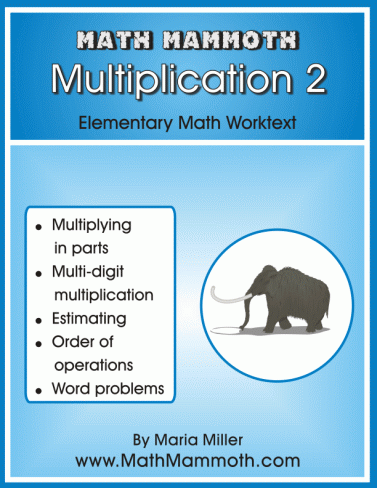
Math Mammoth Multiplication 2 math book cover

Math mammoth Multiplication 2


This book concentrates on multi-digit multiplication, first explaining what it is based on (multiplying in parts), then practicing the algorithm. also included: order of operations, multiplying with money, and lots of word problems.


See sample pages here: (PDF)

Contents & Introduction
Multiply by Whole Tens and Hundreds
Multiply in Parts
Multiplying in Columns, Standard Way
Error of Estimation
Order of Operations
Money and Change
Multiplying 3-digit by 2-digit


Math Mammoth Division 2 math book cover

Math Mammoth Division 2


This book includes lessons on division, long division, the remainder, part problems, average, and problem solving.


See samples:
Contents and Introduction
Division Terms, Zero and One
Finding Parts with Division
Long Division 1
Long Division with 4-Digit Numbers
Average
Divisibility Rules

NOTE: Multiplication 2 and Division 2 now replace the earlier book called Multiplication Division 2.


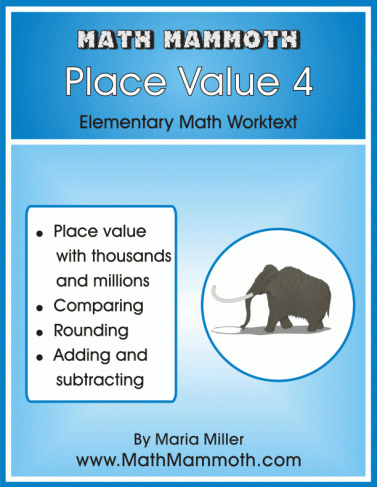
Math Mammoth Place Value 4 math book cover

Math Mammoth Place Value 4


In this book, the focus is on place value with
thousands, ten thousands, and hundred thousands. We also study numbers with millions a little. The book is most suitable for third or fourth grade.


See sample pages (PDF):
Contents
Thousands
Rounding
Estimating
A Little Bit of Millions

New Math Mammoth books: Multiplication 2, Division 2, Place Value 4

Some recent additions to Math Mammoth Blue Series books:

Math Mammoth Multiplication 2 math book cover

Math mammoth Multiplication 2


This book concentrates on multi-digit multiplication, first explaining what it is based on (multiplying in parts), then practicing the algorithm. also included: order of operations, multiplying with money, and lots of word problems.


See sample pages here: (PDF)

Contents & Introduction
Multiply by Whole Tens and Hundreds
Multiply in Parts
Multiplying in Columns, Standard Way
Error of Estimation
Order of Operations
Money and Change
Multiplying 3-digit by 2-digit


Math Mammoth Division 2 math book cover

Math Mammoth Division 2


This book includes lessons on division, long division, the remainder, part problems, average, and problem solving.


See samples:
Contents and Introduction
Division Terms, Zero and One
Finding Parts with Division
Long Division 1
Long Division with 4-Digit Numbers
Average
Divisibility Rules

NOTE: Multiplication 2 and Division 2 now replace the earlier book called Multiplication Division 2.


Math Mammoth Place Value 4 math book cover

Math Mammoth Place Value 4


In this book, the focus is on place value with
thousands, ten thousands, and hundred thousands. We also study numbers with millions a little. The book is most suitable for third or fourth grade.


See sample pages (PDF):
Contents
Thousands
Rounding
Estimating
A Little Bit of Millions

Tuesday, October 23, 2007

Multiplying in parts and the standard algorithm

I haven't blogged for a while but I've been thinking about this topic for a little while now. It is your multiplication algorithm, also called long multiplication, or multiplying in columns. I also happen to be writing a lesson about it for my upcoming LightBlue series 4th grade book.

The standard multiplication algorithm is not awfully difficult to learn. Yet, some books advocate using so-called lattice multiplication instead. I assume it is because the standard method is perceived as being more difficult. But let's look at it in detail.

Before teaching the standard algorithm, consider explaining to the students multiplying in parts, a.k.a. partial products algorithm in detail:

To multiply 7 × 84, break 84 into 80 and 4 (its tens and ones). Then multiply those parts separately, and lastly add.

So we calculate the partial products first: 7 × 80 = 560 and 7 × 4 = 28. Then we add them: 560 + 28 = 588.

If you practice that for one whole lesson before embarking on the actual algorithm, how much better prepared the kids will be!

Next, they will see the standard way of multiplying:


2 
84
× 7

588


Obviously, the steps here are the same. You multiply the ones first: 7 × 4 = 28, write down 8 of the ones, and carry the 2 of the tens. then you multiply 7 × 8 = 56, add 2 to get 58 and write that down in tens place.

What about this way of writing it down?


84
× 7

28
+ 560

588


It uses a little more space, but the underlying principle of multiplying in parts is more obvious.

It works with two two-digit numbers as well:


 84
×   47

28
560
160
3200

3948


Now, the individual multiplications are 7 × 4, then 7 × 80, then 40 × 4 and lastly 40 × 80.

Lastly, I'll touch on lattice multiplication. It uses the same exact principles; however I am not sure if it makes the underlying principle any more obvious to the students than the standard algorithm (and it does take more time and space).

8 4
+---+---+
|5 /|2 /|
| / | / | 7
5 |/ 6|/ 8|
+---+---+
8 8

Answer 588.

Check out Lattice Multiplication to learn how it's actually done; it's hard to explain without images.

Either way, you NEED to explain multiplying in parts to the students. In this case it's not enough just to be able to go through the motions of an algorithm, because multiplying in parts is so needful in everyday life, and later in algebra (distributive property).

Consider for example these mental multiplications you might encounter while shopping:

5 × $14.
Just do 5 × $10 = $50 and 5 × $4 = $20, and add those. Answer $70. I'm sure most of us are quite used to doing such simple products mentally.

4 × $3.12. Go 4 × $3 = $12 and 4 × 12 ¢; = 48 ¢, and add. Answer $12.48.

Multiplying in parts and the standard algorithm

I haven't blogged for a while but I've been thinking about this topic for a little while now. It is your multiplication algorithm, also called long multiplication, or multiplying in columns. I also happen to be writing a lesson about it for my upcoming LightBlue series 4th grade book.

The standard multiplication algorithm is not awfully difficult to learn. Yet, some books advocate using so-called lattice multiplication instead. I assume it is because the standard method is perceived as being more difficult. But let's look at it in detail.

Before teaching the standard algorithm, consider explaining to the students multiplying in parts, a.k.a. partial products algorithm in detail:

To multiply 7 × 84, break 84 into 80 and 4 (its tens and ones). Then multiply those parts separately, and lastly add.

So we calculate the partial products first: 7 × 80 = 560 and 7 × 4 = 28. Then we add them: 560 + 28 = 588.

If you practice that for one whole lesson before embarking on the actual algorithm, how much better prepared the kids will be!

Next, they will see the standard way of multiplying:


2 
84
× 7

588


Obviously, the steps here are the same. You multiply the ones first: 7 × 4 = 28, write down 8 of the ones, and carry the 2 of the tens. then you multiply 7 × 8 = 56, add 2 to get 58 and write that down in tens place.

What about this way of writing it down?


84
× 7

28
+ 560

588


It uses a little more space, but the underlying principle of multiplying in parts is more obvious.

It works with two two-digit numbers as well:


 84
×   47

28
560
160
3200

3948


Now, the individual multiplications are 7 × 4, then 7 × 80, then 40 × 4 and lastly 40 × 80.

Lastly, I'll touch on lattice multiplication. It uses the same exact principles; however I am not sure if it makes the underlying principle any more obvious to the students than the standard algorithm (and it does take more time and space).

8 4
+---+---+
|5 /|2 /|
| / | / | 7
5 |/ 6|/ 8|
+---+---+
8 8

Answer 588.

Check out Lattice Multiplication to learn how it's actually done; it's hard to explain without images.

Either way, you NEED to explain multiplying in parts to the students. In this case it's not enough just to be able to go through the motions of an algorithm, because multiplying in parts is so needful in everyday life, and later in algebra (distributive property).

Consider for example these mental multiplications you might encounter while shopping:

5 × $14.
Just do 5 × $10 = $50 and 5 × $4 = $20, and add those. Answer $70. I'm sure most of us are quite used to doing such simple products mentally.

4 × $3.12. Go 4 × $3 = $12 and 4 × 12 ¢; = 48 ¢, and add. Answer $12.48.